
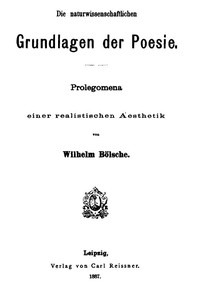
Die naturwissenschaftlichen Grundlagen der Poesie. by Wilhelm Bölsche
This isn't a novel with a plot in the usual sense. Instead, the "story" is Bölsche's intellectual adventure. He starts with a big idea: that the power of poetry and art isn't supernatural. He argues that our love for rhythm, rhyme, and certain images is hardwired into us by evolution and physics.
The Story
Bölsche builds his case step by step. He looks at how natural patterns—like the symmetry of a leaf or the pulse of the ocean—might be the foundation for what we find beautiful. He connects the cadence of poetry to the basic rhythms of life, like breathing and walking. The book is his attempt to map the wild, emotional world of art onto the orderly grid of 19th-century science.
Why You Should Read It
It's a historical brain-teaser. Reading it today, you see the birth of ideas we now take for granted in psychology and aesthetics. You can argue with his conclusions (and many have), but his passionate belief that art is a part of nature, not separate from it, feels fresh. It makes you look at your favorite poem or song and wonder, "What in my biology is making me feel this?"
Final Verdict
This is for the patient and curious reader. It's perfect for fans of big-idea history, early popular science, or anyone who enjoys seeing how people in the past tried to solve the big mysteries of human experience. Don't expect easy answers, but do expect a fascinating conversation with a thinker from another time.
This historical work is free of copyright protections. Knowledge should be free and accessible.
Sarah Miller
5 months agoInitially, I was looking for a specific answer, but the wealth of information provided exceeds the average market standard. A refreshing and intellectually stimulating read.
Barbara Hill
1 year agoMy professor recommended this, and I see why.
Liam Gonzalez
5 months agoSurprisingly enough, the flow of the text seems very fluid. Don't hesitate to start reading.
Brian Nguyen
1 year agoBased on the summary, I decided to read it and the content flows smoothly from one chapter to the next. Exceeded all my expectations.


Patricia Garcia
6 months agoI found the author's tone to be very professional yet accessible, the cross-referencing of different chapters makes it a great study tool. Top-tier content that deserves more recognition.