
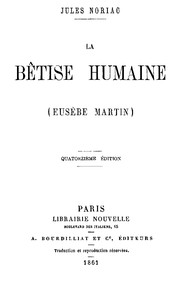
La bêtise humaine (Eusèbe Martin) by Jules Noriac
Jules Noriac's La bêtise humaine is a collection of satirical pieces that poke fun at the everyday foolishness of 19th-century French society. Written under the pen name Eusèbe Martin, Noriac doesn't follow a single plot. Instead, he creates a gallery of characters and scenarios: the blind follower of fashion, the corrupt official hiding behind bureaucracy, the critic who praises terrible art, and the ordinary person convinced by empty slogans. Through these vignettes, he builds a funny and frustrating picture of a world running on vanity, greed, and sheer thoughtlessness.
Why You Should Read It
What's amazing is how fresh this all feels. You'll read a passage about a man buying a hideous piece of furniture just because it's trendy, or a town celebrating a meaningless holiday, and think, "Yep, we still do that." Noriac isn't just being mean; there's a real warmth and disappointment in his writing. He's observing the gap between how people could be and how they often choose to act. The 'stupidity' he writes about isn't a lack of intelligence, but a voluntary surrender of common sense. It's about the choices we make to fit in, to get ahead, or to avoid thinking for ourselves.
Final Verdict
This book is perfect for anyone who enjoys smart satire with historical flavor. If you like authors like Mark Twain or the observational humor of a great stand-up comic, you'll connect with Noriac's voice. It's also a fantastic, accessible peek into the concerns of 19th-century France without feeling like homework. Fair warning: it might make you a little more aware of the 'bêtise' in your own life—and that's a good thing. A clever, timeless, and surprisingly comforting read.
The copyright for this book has expired, making it public property. It serves as a testament to our shared literary heritage.
Ashley Perez
1 year agoAfter a thorough walkthrough of the table of contents, the narrative arc keeps the reader engaged while delivering factual content. The insights gained here are worth every minute of reading.
Susan Gonzalez
8 months agoThe clarity of the concluding remarks is very professional.
Kimberly Rodriguez
4 months agoThis digital copy caught my eye due to its reputation, the wealth of information provided exceeds the average market standard. I appreciate the effort that went into this curation.
Elizabeth Smith
7 months agoAs someone who reads a lot, it creates a vivid world that you simply do not want to leave. I learned so much from this.







Joseph Anderson
11 months agoI was particularly interested in the case studies mentioned here, the footnotes provide extra depth for those who want to dig deeper. I’ll definitely be revisiting some of these chapters again soon.