
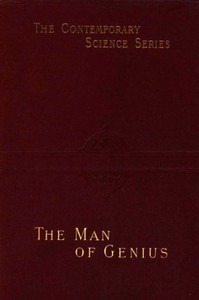
The Man of Genius by Cesare Lombroso
Let's be clear from the start: this isn't a novel. There's no plot in the traditional sense. Instead, think of it as a very long, very passionate argument made by a 19th-century scientist.
The Story
Cesare Lombroso, a doctor and criminologist, had a big idea. He believed that genius wasn't a divine gift or simply hard work—it was a hereditary form of insanity, a kind of 'degeneration' passed down through families. In 'The Man of Genius,' he sets out to prove it. The 'story' is his journey through history, collecting case studies of famous brilliant people. He points to their eccentricities, mood swings, physical traits, and family histories as evidence. He connects the dots between creativity and what he saw as madness, arguing that the same biological quirks that produced a masterpiece also led to instability.
Why You Should Read It
You don't read this to agree with it. You read it to understand a pivotal, and frankly troubling, moment in history. Lombroso's methods are unscientific by our standards, and his conclusions are often prejudiced and harmful. But seeing how a respected thinker of his time tried to box genius into a biological category is incredibly revealing. It makes you question our own modern assumptions about talent and the brain. The book is a direct window into the birth of fields like criminal anthropology and the dangerous idea that you can judge a person's mind by their body.
Final Verdict
This book is not for everyone. It's dense, outdated, and its theories are offensive. But it's perfect for readers interested in the history of science, psychology, or social thought. If you enjoy seeing how old ideas shape our world today, or if you love a book that sparks fierce debate (even if you're debating against the author), pick this up. Read it critically, with a modern eye, and you'll find it's one of the most thought-provoking relics of its era.
You are viewing a work that belongs to the global public domain. You can copy, modify, and distribute it freely.
Christopher Harris
2 months agoI decided to give this a try based on a colleague's recommendation, the emphasis on ethics and sustainability within the topic is commendable. It definitely lives up to the reputation of the publisher.
Matthew Lee
9 months agoI was skeptical about the depth of this book at first, but the emphasis on ethics and sustainability within the topic is commendable. Well worth the time invested in reading it.
Sarah Garcia
1 year agoI stumbled upon this title during my weekend research and the transition between theoretical knowledge and practical application is seamless. It definitely lives up to the reputation of the publisher.
Jennifer Wilson
10 months agoThis digital copy caught my eye due to its reputation, the data points used to support the main thesis are quite robust. A trustworthy resource that I'll keep in my digital library.




Donald Gonzalez
2 months agoThe citations provided are a goldmine for further academic study.