About 477 minutes
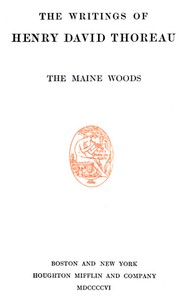
The Maine Woods The Writings of Henry David Thoreau, Volume 03 (of 20) — A Reader’s Guide
Places Peoples
109,638 recorded words. 46 minutes difference from this book's estimate.
View Gutenberg source #42500
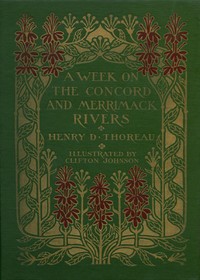
For A Week on the Concord and Merrimack Rivers — Inside the Classic, the stored edition analysis reports 120,061 words, 8 hr 43 min estimated reading time, and 17 detected text sections.
The text analysis averages about 26.8 words per sentence, while the detected sections provide another way to judge how the source is divided.
Project Gutenberg metadata also associates the work with “Concord River (Mass.) -- Description and travel,” connecting these edition facts with the source record’s subject description.
Explore this collection
These alternatives are selected using recorded categories and estimated reading time.
About 477 minutes
Places Peoples
109,638 recorded words. 46 minutes difference from this book's estimate.
View Gutenberg source #42500About 461 minutes
Places Peoples
105,863 recorded words. 62 minutes difference from this book's estimate.
View Gutenberg source #43997About 434 minutes
Places Peoples
99,802 recorded words. 89 minutes difference from this book's estimate.
View Gutenberg source #19209Search stored excerpts and compare books → Choose by your preferences →
Choices use stored catalog measurements. Estimates vary with reading speed. A shared category is a catalog label, not a claim that two books have the same argument or literary quality.
Search reads excerpt text stored with this catalog and links to its associated Gutenberg record. The connection is stored in the site database; this tool does not recheck that every excerpt is word-for-word identical to that external record. Excerpt search does not cover every chapter and does not verify historical publication dates.
Catalog snapshot checked: 2026-09-25. Coverage: 95 public books, 95 available source excerpts.
Read the complete public-domain text at its original source.
Read on Project GutenbergThoreau opens his account of a week-long boat voyage with a meditation on naming: the Concord River was once the Musketaquid, or Grass-ground River, and he insists that its identity shifts with the people who dwell on its banks. This attention to the gap between indigenous and colonial names—and the layers of history they encode—sets the pattern for a book that is as much about the act of traveling as it is about the rivers themselves. The narrative moves between precise descriptions of currents and sandbars and digressions into poetry, philosophy, and local lore, creating a texture that is part travelogue, part essay.
Thoreau treats the river as a repository of memory, both natural and human. He notes that the Concord's grassy meadows attracted settlers in 1635, but also that the same ground was once hunting and fishing territory for an “extinct race.” The river itself is older than any civilization, “probably as old as the Nile or Euphrates,” yet its meaning changes with each generation. Thoreau is alert to the physical traces of the past: the plow that unearths an Indian pipe or arrow, the farmers who own the Great Meadows and cut hay year after year. He does not simply describe the landscape; he reads it as a palimpsest, where the present is always in dialogue with what came before. This layered sense of time gives the journey a meditative quality, as if each bend in the river might reveal another stratum of history.
One of the most striking episodes in the excerpts involves Thoreau's search for lodging in a remote mountain valley. He approaches the house of a man named Rice, who is described by locals as “rather rude and uncivil.” When Thoreau asks if they entertain travelers, Rice answers gruffly and retreats to a distant stall. Yet Thoreau pardons this incivility, attributing it to “the wildness of the scenery.” The house has no sign-post, only the owner's name fastened outside—a “sullen invitation.” This moment crystallizes a recurring tension in the book: the contrast between the idealized hospitality of rural life and the actual, often guarded, encounters with strangers. Thoreau's willingness to interpret rudeness as a natural extension of the landscape reveals his tendency to romanticize even discomfort, transforming a social slight into a philosophical observation.
The structure of the narrative follows the days of the week, but the excerpts show that Thoreau is less concerned with chronological progress than with the rhythm of observation and reflection. He notes how the hills “grew more and more frequent” and “gradually swelled into mountains,” hemming in the river until he cannot see where it comes from. This sense of enclosure and mystery is deliberate: he is “at liberty to imagine the most wonderful meanderings and descents.” The journey becomes an inner as well as an outer exploration. At noon he sleeps on the grass; at nightfall he finds himself in a “romantic and retired valley.” The physical movement upriver is matched by a movement inward, toward solitude and contemplation. The book's episodic structure—each day a new section—allows Thoreau to shift between narrative, description, and digression without losing the thread of the voyage.
Readers approaching A Week on the Concord and Merrimack Rivers should expect a work that resists easy categorization. It is part travel narrative, part philosophical essay, and part natural history, held together by the steady current of Thoreau's prose. Pay attention to the moments when he pauses to quote a poet or to reflect on a name—these are the places where the book's deeper concerns surface. The journey may be a week long, but the thinking it provokes extends far beyond the riverbanks.
Reading about Thoreau’s slow drift between wild banks and settled towns, I remembered staring out a rainy window while tracing Orinoco tributaries on a map, feeling that same ache for a horizon just beyond the next bend. Each book carries a quiet, patient longing. The Andes and the Amazon; Or, Across the Continent of South America — Text and Context stirred that old wanderlust, much as this river journey does now.
Use these questions to collect your thoughts before moving on.