About 477 minutes
The Maine Woods The Writings of Henry David Thoreau, Volume 03 (of 20) — A Reader’s Guide
Places Peoples
109,638 recorded words. 16 minutes difference from this book's estimate.
View Gutenberg source #42500
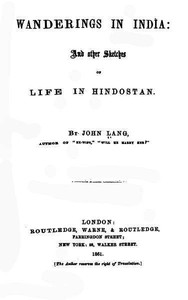
For Wanderings in India, and Other Sketches of Life in Hindostan — A Reader’s Guide, the stored edition analysis reports 105,863 words, 7 hr 41 min estimated reading time, and 10 detected text sections.
The text analysis averages about 20.6 words per sentence, while the detected sections provide another way to judge how the source is divided.
Project Gutenberg metadata also associates the work with “India -- Description and travel,” connecting these edition facts with the source record’s subject description.
Explore this collection
These alternatives are selected using recorded categories and estimated reading time.
About 477 minutes
Places Peoples
109,638 recorded words. 16 minutes difference from this book's estimate.
View Gutenberg source #42500About 434 minutes
Places Peoples
99,802 recorded words. 27 minutes difference from this book's estimate.
View Gutenberg source #19209About 523 minutes
Places Peoples
120,061 recorded words. 62 minutes difference from this book's estimate.
View Gutenberg source #4232Search stored excerpts and compare books → Choose by your preferences →
Choices use stored catalog measurements. Estimates vary with reading speed. A shared category is a catalog label, not a claim that two books have the same argument or literary quality.
Search reads excerpt text stored with this catalog and links to its associated Gutenberg record. The connection is stored in the site database; this tool does not recheck that every excerpt is word-for-word identical to that external record. Excerpt search does not cover every chapter and does not verify historical publication dates.
Catalog snapshot checked: 2026-09-25. Coverage: 95 public books, 95 available source excerpts.
Read the complete public-domain text at its original source.
Read on Project GutenbergJohn Lang opens his account with a detailed description of the Himalaya Club at Mussoorie, a social hub for British officers and civilians escaping the plains' heat. He notes the club's modest architecture—a dining room, a reading room, and a billiard room perched on a precipice—and the striking view of eternal snows and rhododendron-covered hills. This setting immediately establishes Lang's eye for concrete detail and his interest in the intersection of British social life and Indian landscape.
The preface reveals that most of these papers first appeared in Household Words, edited by Charles Dickens, suggesting a readership accustomed to lively, observational prose. Lang's tone is direct and often critical, as seen in his dialogue with a native official who decries the inequities of the land settlement system. The excerpts show a writer who moves between descriptive travelogue and pointed political commentary, grounding his observations in specific places and conversations.
Lang's description of the Himalaya Club is meticulously physical: the lower room serves as dining, breakfast, and reception space; the upper room doubles as a reading and ballroom; the billiard room is built on a ledge. He notes that the stables are holes cut into earth and rock, and that only horses educated in India would enter them. This attention to the built environment reveals how the British adapted to the Indian landscape. The club's platform offers a view of eternal snows and hills covered with rhododendrons, which Lang notes grow to immense size and are literally covered with flowers when in bloom. He observes that houses on nearby hills appear inaccessible, yet are whitened inside and out, shining in the sun. These details ground the reader in a specific place and time, showing how Lang uses physical description to convey the strangeness and beauty of the Himalayan setting.
A central excerpt features a dialogue between Lang and an unnamed native official about the perpetual settlement of Bengal. The official argues that the settlement, established under Lord Cornwallis, was riddled with fraud: natives who bribed settlement officers secured vast tracts at nominal rents, while poorer zemindars were heavily taxed. He cites the Durbungah Rajah, who pays half a lac per annum while collecting over twenty lacs. The official contends that the British government should resettle Bengal, despite cries of breach of faith. Lang's interlocutor claims that in Upper India, people would welcome such a change out of envy. The official further asserts that zemindars would not assist the British in a crisis, remaining neutral until the final blow. This exchange reveals Lang's willingness to present critical perspectives on British policy, and his use of dialogue to dramatize political arguments.
Throughout the excerpt, Lang gives extended voice to a native speaker who challenges British assumptions. The official's language is forceful and direct: he describes the zemindars as men who 'get hold of the money and bury it,' and predicts they would not lift a finger to help the government. He claims to know his countrymen better than Lang does, and his arguments are grounded in specific economic details—the disparity between tax rates in Bengal and the Upper Provinces, the profitability of large estates. This is not a passive informant but a sharp critic. Lang does not rebut him; instead, he lets the speech stand, creating a polyphonic text that complicates any simple colonial narrative. The reader is left to weigh the official's claims against Lang's own observations, a technique that invites critical engagement.
The excerpts show Lang moving between two modes: descriptive travelogue and political debate. The opening pages of 'The Himalaya Club' are purely descriptive, focusing on architecture and scenery. But later sections shift to dialogue and argument, as Lang records conversations about land policy, taxation, and loyalty. This structural variety suggests that the book is not a straightforward travel narrative but a collection of sketches that blend genres. Lang's prose is plain and factual, even when reporting controversial opinions. He does not editorialize heavily; instead, he presents scenes and speeches, allowing readers to draw their own conclusions. This approach, typical of the periodical sketches that first appeared in Household Words, makes the text feel immediate and reportorial, as if Lang is a journalist filing dispatches from the field.
Lang's sketches reward a reader attentive to both setting and argument. The physical details—the club on a precipice, the stables cut into rock—anchor the political discussions in a tangible world. As you read, note how Lang uses dialogue to introduce perspectives that might challenge his own, and how he balances description with debate. The book is less a continuous narrative than a series of scenes; each chapter can be approached as a standalone piece. Pay attention to the voices of native speakers, who often carry the most pointed critiques. This is a text that asks its readers to look closely at the landscape and listen carefully to the conversations.
Reading Lang’s descriptions of dusty plains and hill-station verandas, I remembered sitting on my grandfather’s porch, listening to his old stories. That same unhurried ache of far places returned. Years ago, The Andes and the Amazon; Or, Across the Continent of South America — Text and Context gave me that identical feeling—not of travel, but of time passing quietly between two people who once tried to capture the world in words.
Create a short personal record of your experience with this book.