About 697 minutes
Up the Orinoco and down the Magdalena — Background and Themes
Geography
160,109 recorded words. 7 minutes difference from this book's estimate.
View Gutenberg source #45848
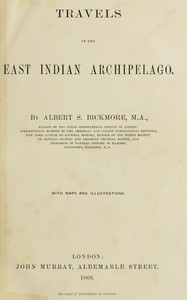
Travels in the East Indian archipelago — Text and Context can be approached with a clearer sense of reading commitment from its source measurements: 161,810 words, 11 hr 44 min estimated reading time, and 31 detected text sections.
The text analysis averages about 26.1 words per sentence, while the detected sections provide another way to judge how the source is divided.
Project Gutenberg metadata also associates the work with “Malay Archipelago -- Description and travel,” connecting these edition facts with the source record’s subject description.
Explore this collection
These alternatives are selected using recorded categories and estimated reading time.
About 697 minutes
Geography
160,109 recorded words. 7 minutes difference from this book's estimate.
View Gutenberg source #45848About 715 minutes
Geography
164,339 recorded words. 11 minutes difference from this book's estimate.
View Gutenberg source #14613About 690 minutes
Geography
158,680 recorded words. 14 minutes difference from this book's estimate.
View Gutenberg source #72622Search stored excerpts and compare books → Choose by your preferences →
Choices use stored catalog measurements. Estimates vary with reading speed. A shared category is a catalog label, not a claim that two books have the same argument or literary quality.
Search reads excerpt text stored with this catalog and links to its associated Gutenberg record. The connection is stored in the site database; this tool does not recheck that every excerpt is word-for-word identical to that external record. Excerpt search does not cover every chapter and does not verify historical publication dates.
Catalog snapshot checked: 2026-09-25. Coverage: 95 public books, 95 available source excerpts.
Read the complete public-domain text at its original source.
Read on Project GutenbergAlbert S. Bickmore opens his 1868 narrative with a specific scientific mission: to re-collect the shells figured in Rumphius’s “Rariteit Kamer.” The preface reveals that the idea of writing a travel volume emerged only after he arrived at Batavia and received unexpected support from the Dutch Governor-General. Bickmore emphasizes that his account is drawn “almost entirely from my journal, which was kept day by day with scrupulous care,” and that he aimed for “accuracy, even at any sacrifice of elegance.” This commitment to firsthand, dated observation sets the tone for a work that prioritizes factual detail over literary flourish.
Bickmore’s preface establishes a disciplined approach: first impressions are recorded and later “modified by subsequent observation.” The narrative structure follows his chronological journey, beginning with the Strait of Sunda and Batavia. The excerpts show that he frequently notes dates, distances, and specific natural phenomena—such as the “veil of rain” and “balmy breezes of the Eastern Isles” in the opening chapter. This methodical recording allows readers to track his evolving understanding of the archipelago’s geography and ecology. The journal format also explains the occasional shifts between descriptive passages and factual asides, as when he interrupts a scenic description to list the historical eruptions of a volcano.
Bickmore’s descriptions of islands like Bachian, Makian, and Ternate blend vivid natural imagery with precise geological and historical data. He notes that Bachian’s northern part is “of sedimentary origin of various ages” while the south is volcanic, and that gold has been washed there since 1774. For Makian, he recounts the 1646 eruption that split the mountain in two, and the 1862 eruption that “destroyed nearly every one on the whole island,” with ash falling forty miles away at Ternate. These passages demonstrate his habit of weaving together eyewitness observation, local accounts, and earlier written sources such as Valentyn and Junghuhn. The result is a layered portrait of a dynamic, dangerous environment.
One of the most striking passages in the excerpts describes the view of Ternate at sunrise: “the whole grand sight above, perfectly mirrored beneath in the quiet sea.” Bickmore contrasts the “imposing” vertical column of volcanic gas rising from the peak with the “charming” reflection on the water. He notes that this was the first cultivated mountain he had seen since leaving Java, and describes the “small ridges” and “plateau-like areas” where natives had cleared gardens, with smoke rising “as if from sacrificial altars.” Such moments reveal his eye for composition and his ability to convey both the sublime power of nature and the human presence within it.
Bickmore occasionally reflects on the tools and technologies that enable his journey. During a stormy night with “no moon, no stars, no light in the whole heavens,” he feels “the inestimable value of the mariner’s compass.” He also expresses relief at being on a steamer rather than the “old prau” he had expected. These asides remind readers that his travels depend on both traditional seamanship and modern steam power. The narrative itself functions as a kind of compass, guiding readers through a complex archipelago by means of careful chronological and geographical markers. Bickmore’s habit of naming islands, straits, and historical events provides a reliable framework for following his route.
Readers approaching Bickmore’s work for the first time will benefit from paying attention to his dated journal entries and the way he integrates scientific data with personal observation. The narrative rewards those who read with a map at hand, as the author’s precise geographical references trace a real, physical journey. The excerpts suggest that the book’s value lies not in dramatic adventure but in the patient, accurate recording of a world in motion—volcanic, botanical, and human.
I came across Albert Bickmore’s quiet 1868 journal, noticing how he wrote simply about what he saw each day—tides, shells, a distant eruption. It reminded me of a later traveler, Mark Twain, who likewise kept his eyes open but let his wonder wander into wry commentary. Both men watched the world pass with unhurried patience. That same reflective pace lingers in Following the Equator: A Journey Around the World. Part 2 — Edition Insights, like an old photograph slowly developing.
Capture what you thought, learned, and would like to remember.