About 410 minutes
Travels in Kordofan — Reading Companion
Geography
94,171 recorded words. 15 minutes difference from this book's estimate.
View Gutenberg source #71182
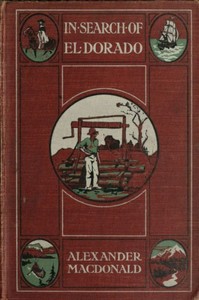
Before opening In Search of El Dorado: A Wanderer's Experiences — Themes and Context, the edition data offers a quick orientation: 90,740 words, 6 hr 35 min estimated reading time, and 12 detected text sections.
The text analysis averages about 21.2 words per sentence, while the detected sections provide another way to judge how the source is divided.
Project Gutenberg metadata also associates the work with “Voyages and travels,” connecting these edition facts with the source record’s subject description.
Explore this collection
These alternatives are selected using recorded categories and estimated reading time.
About 410 minutes
Geography
94,171 recorded words. 15 minutes difference from this book's estimate.
View Gutenberg source #71182About 379 minutes
Geography
86,963 recorded words. 16 minutes difference from this book's estimate.
View Gutenberg source #35659About 421 minutes
Geography
96,791 recorded words. 26 minutes difference from this book's estimate.
View Gutenberg source #48835Search stored excerpts and compare books → Choose by your preferences →
Choices use stored catalog measurements. Estimates vary with reading speed. A shared category is a catalog label, not a claim that two books have the same argument or literary quality.
Search reads excerpt text stored with this catalog and links to its associated Gutenberg record. The connection is stored in the site database; this tool does not recheck that every excerpt is word-for-word identical to that external record. Excerpt search does not cover every chapter and does not verify historical publication dates.
Catalog snapshot checked: 2026-09-25. Coverage: 95 public books, 95 available source excerpts.
Read the complete public-domain text at its original source.
Read on Project GutenbergAlexander MacDonald's account of gold-seeking in Australia and Alaska opens with a striking contrast: Admiral John Moresby's introduction frames the quest for El Dorado as a timeless human instinct, a 'glittering phantom' that has lured adventurers since antiquity. Yet the narrative itself quickly grounds this romance in the gritty particulars of a failed expedition. In one excerpt, MacDonald's party, exhausted and low on water, stumbles upon a spring hidden behind a boulder—a small relief that underscores the constant, unglamorous struggle against heat, thirst, and failing pack animals. The men's dialogue, rendered in Scots dialect ('the puir beastie's feenished'), adds a layer of vernacular authenticity, while their wary humor ('I hope our landlords do not visit us to-night') reveals a tension between bravado and genuine fear. This editorial note examines the specific tensions, contrasts, and patterns visible in the supplied text, focusing on three key aspects: the interplay of romantic expectation and physical ordeal, the role of dialect and voice in shaping character, and the narrative's treatment of Indigenous peoples as both threat and resource.
Moresby's introduction sets a high romantic tone, invoking Sir Philip Sidney and the 'treasure-guarding dragons of fairy-tales.' He insists these are 'true romances—no fiction with its Deus ex machina at the psychological moment.' Yet MacDonald's narrative immediately undercuts this. The party's horses collapse; the men debate whether the local blacks are cannibals; and the spring they find is 'half hidden by an outjutting boulder' and 'cunningly screened from view'—a detail that suggests the landscape itself is deceptive. The gold, if any, remains absent from these excerpts. Instead, the reader encounters the 'dying embers of a fire,' scattered weapons, and the 'uninspiring nature of our environment.' The romantic quest is thus reframed as a series of small, often thwarted efforts to survive. MacDonald does not deny the allure of gold, but his evidence points to a narrative more concerned with the cost of the search than its reward.
MacDonald renders his companions' speech in broad Scots, creating a distinct auditory texture. Mac's 'the deevil's ain countrie' and Stewart's 'their spears ha' an ex-tra-or'-nar' bluid-thirsty look' contrast with MacDonald's own more standard English narration. This linguistic layering serves several purposes: it marks the men as outsiders in the Australian bush, it provides comic relief (Mac's 'we shidna forget that such inceedents serve a vera usefu' purpose'), and it conveys a shared, weary camaraderie. The Scots dialect is not merely decorative; it signals a specific cultural background and a pragmatic, often fatalistic attitude toward hardship. When Mac calls a horse 'the puir beastie,' the phrase carries more pathos than a plain English equivalent. This attention to voice suggests that MacDonald is as interested in the men who seek gold as in the gold itself.
The excerpts depict Aboriginal Australians primarily through the lens of threat and flight. The party finds a campsite 'littered with fragments of brushwood' and 'shields, spears, and boomerangs' left behind by a 'fleeing horde.' The men's reactions range from Mac's curse ('consigned the blacks generally to a very warm climate indeed') to Stewart's uneasy speculation about cannibalism. Yet there is also a hint of grudging respect: Stewart calls them 'rale dacent black buddies' in a moment of reflection, and MacDonald notes that the breakwind and well-worn track indicate 'the blacks were in the habit of camping here frequently.' The narrative does not romanticize or demonize uniformly; instead, it presents a colonial perspective that is wary, pragmatic, and occasionally curious. The spring itself is 'cunningly screened'—a detail that implies Indigenous knowledge of the landscape, though MacDonald does not explicitly credit it.
Readers approaching In Search of El Dorado should attend to the gaps between Moresby's heroic framing and MacDonald's ground-level reportage. The narrative rewards attention to small details: the condition of the horses, the quality of the spring water, the precise wording of a Scots complaint. These elements, rather than any discovery of gold, constitute the book's real substance. The excerpts suggest a work that is less a triumphant adventure story than a patient, often weary record of endurance in two harsh goldfield environments.
MacDonald’s gold-seekers chased a shimmer that crumbled to dust, yet their diaries hum with stubborn hope. I find the same quiet ache in Henry Irving's Impressions of America Narrated in a Series of Sketches, Chronicles, and Conversations — Edition Insights—a performer gripping applause that vanishes mid-curtain. Both books whisper of lands promised, then measured in blistered feet or hollow cheers. A shared, tender bewilderment.
A brief reflection can help important ideas stay with you longer.