About 421 minutes
Sport in the Crimea and Caucasus — Inside the Classic
Geography
96,791 recorded words. 11 minutes difference from this book's estimate.
View Gutenberg source #48835
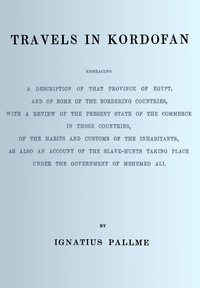
The catalog record for Travels in Kordofan — Reading Companion provides practical reading context through 94,171 words, 6 hr 50 min estimated reading time, and 8 detected text sections.
The text analysis averages about 32.3 words per sentence, while the detected sections provide another way to judge how the source is divided.
Project Gutenberg metadata also associates the work with “Nile River,” connecting these edition facts with the source record’s subject description.
Explore this collection
These alternatives are selected using recorded categories and estimated reading time.
About 421 minutes
Geography
96,791 recorded words. 11 minutes difference from this book's estimate.
View Gutenberg source #48835About 395 minutes
Geography
90,740 recorded words. 15 minutes difference from this book's estimate.
View Gutenberg source #41530About 429 minutes
Geography
98,519 recorded words. 19 minutes difference from this book's estimate.
View Gutenberg source #40394Search stored excerpts and compare books → Choose by your preferences →
Choices use stored catalog measurements. Estimates vary with reading speed. A shared category is a catalog label, not a claim that two books have the same argument or literary quality.
Search reads excerpt text stored with this catalog and links to its associated Gutenberg record. The connection is stored in the site database; this tool does not recheck that every excerpt is word-for-word identical to that external record. Excerpt search does not cover every chapter and does not verify historical publication dates.
Catalog snapshot checked: 2026-09-25. Coverage: 95 public books, 95 available source excerpts.
Read the complete public-domain text at its original source.
Read on Project GutenbergIgnaz Pallme opens his account with a frank admission: his journey was 'strictly mercantile in its tendency,' not that of a trained scientist. Yet the preface reveals a careful observer who, during nineteen months of travel, filled his journal with details that range from trade routes to the origin myth of skin color as recounted by an old negro. The work is presented as a 'short guide' for future explorers, and its pages are studded with the kind of practical, unvarnished observations that come from a resident, not a passing visitor.
Pallme's preface establishes his credentials: proficiency in Arabic, prior travels in the Soudan, and acquaintance with merchants from distant provinces. He undertook the journey at a friend's request to investigate whether trade could bypass intermediaries. This commercial lens shapes the entire narrative. Unlike scientific travelers such as Dr. Rueppel or Conseillier des Mines Russegger—whose stays were brief and conducted 'in so much company'—Pallme traveled alone or in small groups, allowing him to note details others might miss. His observations on the slave hunts 'taking place under the government of Mehemed Ali' are presented as part of the region's economic reality, not as moral commentary. The reader should expect a text that prioritizes practical information over literary flourish.
One of the most striking passages recounts an old negro's explanation for the existence of different skin colors. In this version, Eve (Hauve) bears hundreds of children daily; God (Abou) rejects darker babies and later finds blackened children hidden in an oven, decreeing their color permanent. Pallme records this as an example of how 'Mahommedan negroes' mix 'a great deal of superstition with the Koran.' He also notes their belief in metempsychosis: apes, elephants, and parrots are thought to house human souls, so harming a monkey might mean striking one's own grandfather. These details reveal both Pallme's ethnographic curiosity and his cultural distance—he does not endorse these beliefs, but he does not dismiss them outright. The passage ends with a note that the 'saints' common in Egypt are not tolerated in Kordofan, except for two exceptions, one of whose grave still draws pilgrims.
Pallme's prose is direct and unadorned, matching his stated purpose. He writes in the first person, often addressing the reader with phrases like 'I noted down in my journal everything that appeared to me remarkable.' The text is organized not as a continuous story but as a series of observations, each tied to a specific place or topic. The excerpts show a preference for concrete detail over abstraction: the oven story is vivid, the description of the saint's grave is precise ('two hours' march from Lobeid'). Pallme is aware of his limitations—he cannot offer 'so explicit a description as might be expected of a traveller or a man well versed in the various sciences'—but he compensates with honesty and specificity. This is a work that trusts the reader to extract value from raw, firsthand notes.
Pallme's Travels in Kordofan rewards readers who approach it as a primary source rather than a polished travelogue. The text is dense with incidental details—the cost of goods, the layout of markets, the habits of local animals—that a more literary writer might omit. For those interested in the everyday mechanics of 1840s Sudan under Egyptian rule, this is an invaluable document. Read it with a map at hand, and be prepared to follow Pallme's digressions; they are where the most telling observations lie.
My grandfather kept a ledger of prices from his travels, much like Pallme’s journal of Kordofan’s markets; the numbers felt cold until I noticed his margin notes about the people. That ache of humanity beneath commerce surfaced again in the Letters from the Alleghany Mountains — Key Ideas to Explore, where wilderness letters whisper the same quiet loneliness and wonder I felt turning those old pages.
Create a short personal record of your experience with this book.