About 461 minutes
The Log of a Sea-Waif: Being Recollections of the First Four Years of My Sea Life — Context and Discussion
Geography
106,026 recorded words. 1 minutes difference from this book's estimate.
View Gutenberg source #36657
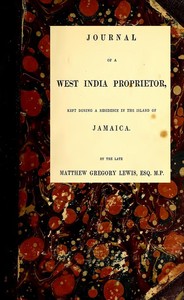
Before opening Journal of a West India Proprietor Kept During a Residence in the Island of Jamaica — Reading Notes, the edition data offers a quick orientation: 106,122 words, 7 hr 42 min estimated reading time, and 11 detected text sections.
The text analysis averages about 33.2 words per sentence, while the detected sections provide another way to judge how the source is divided.
Project Gutenberg metadata also associates the work with “Slavery -- Jamaica,” connecting these edition facts with the source record’s subject description.
Explore this collection
These alternatives are selected using recorded categories and estimated reading time.
About 461 minutes
Geography
106,026 recorded words. 1 minutes difference from this book's estimate.
View Gutenberg source #36657About 456 minutes
Geography
104,653 recorded words. 6 minutes difference from this book's estimate.
View Gutenberg source #45505About 470 minutes
Geography
107,922 recorded words. 8 minutes difference from this book's estimate.
View Gutenberg source #37205Search stored excerpts and compare books → Choose by your preferences →
Choices use stored catalog measurements. Estimates vary with reading speed. A shared category is a catalog label, not a claim that two books have the same argument or literary quality.
Search reads excerpt text stored with this catalog and links to its associated Gutenberg record. The connection is stored in the site database; this tool does not recheck that every excerpt is word-for-word identical to that external record. Excerpt search does not cover every chapter and does not verify historical publication dates.
Catalog snapshot checked: 2026-09-25. Coverage: 95 public books, 95 available source excerpts.
Read the complete public-domain text at its original source.
Read on Project GutenbergMatthew Gregory Lewis, already famous as the author of The Monk, opens his Journal of a West India Proprietor not with the tropics but with a dreary inn at Gravesend, where he waits to embark for Jamaica. The first entry, dated November 8, 1815, sets a tone of wry observation: he compares the despondency of a pig being wheeled aboard to a tragic actress's performance. This blend of literary allusion and sharp-eyed detail—the pigs squeaking, the sky dingy—establishes Lewis as a narrator who sees the world through a theatrical, ironic lens. The journal records two residences on his sugar plantations, and the excerpts reveal a writer equally attentive to the natural world, the condition of enslaved people, and his own position as an absentee proprietor.
The opening pages of the journal are dominated by the sea voyage and Lewis's first impressions of Jamaica. He records the shipboard routine, the other passengers, and his own seasickness with a novelist's eye for character. The entry for November 10 describes the embarkation on the Sir Godfrey Webster and the shrieks from a nearby boat—a moment that might be comic or ominous. Lewis's voice is consistently self-aware: he quotes Virgil, alludes to Hannah More, and frames his own discomfort as a kind of performance. These early passages establish the journal as a literary artifact, not merely a factual record. The reader is invited to watch Lewis watching himself, a posture that persists throughout the text.
Once on the island, Lewis turns his attention to the landscape and its produce. The entry for March 9, 1817, offers a detailed account of the shaddock's seeds, the varieties of mango, and the dangers of cassava. He notes that seeds from a single shaddock can yield sweet oranges, bitter oranges, or forbidden fruit, and that no one can predict the outcome until the tree bears. This botanical observation is typical of Lewis's method: he moves from specific fact to broader reflection. He also describes the practice of ratooning sugar cane, noting that on his estate in St. Thomas's in the East, ten ratoons are allowed, while at Cornwall the cane exhausts itself by the fourth. These passages ground the journal in the material realities of plantation agriculture.
Lewis interrupts his prose with a poem, “The Humming Bird,” dated March 8. The poem tells of Zoè, a sable maid, and a humming bird that sips from an orange blossom only to find bees have drained it. The bird's anger and flight to a rose become a lesson from mother to daughter about faithless lovers. Lewis frames the poem with a note that British mothers teach similar maxims, and Zoè “used the lesson just as British daughters do.” The poem is a curious blend of natural description, moral allegory, and self-conscious irony. It reveals Lewis's literary ambitions and his tendency to see Jamaican life through European literary forms. The reader may wonder how this poetic interlude relates to the journal's other concerns.
Throughout the journal, Lewis records his observations on the enslaved people on his estates. The excerpts include a note about a young man who has lost the use of one side without hope of recovery—a stark reminder of the human cost of plantation life. Lewis does not dwell on the institution of slavery in the abstract; instead, he offers glimpses of individual lives and his own responses. His position as an absentee proprietor who visits his holdings gives the journal a particular tension: he is both an observer and a participant in the system. The reader must infer his attitudes from his descriptions, as the excerpts do not provide explicit condemnation or defense. The journal's value lies in this ambiguous, first-hand testimony.
Lewis's journal resists easy categorization. It is part travelogue, part natural history, part plantation ledger, and part literary exercise. Readers should approach it as a document of its time, attentive to what Lewis chooses to record and what he omits. The juxtaposition of a poem about a humming bird with a note about a paralyzed enslaved man is characteristic of the work's uneven texture. The journal rewards those who read slowly, noticing the shifts in register and the details that escape the author's control.
Rereading Lewis’s journal, I kept pausing on his small, uneasy attempts to see the island plainly through his literary habits. That same tension—wanting to translate a foreign place into familiar words, yet feeling the weight of what refuses translation—resurfaced in Abroad — A Closer Reading. It felt less like discovery than recognition, the quiet company of a similar restlessness.
Capture what you thought, learned, and would like to remember.