About 45 minutes
The Voyage of the Oregon from San Francisco to Santiago in 1898 — Story, Setting & Ideas
Geography
10,252 recorded words. 8 minutes difference from this book's estimate.
View Gutenberg source #25723
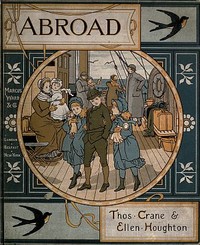
The source record for Abroad — A Closer Reading measures this digital text at 8,346 words, 37 min estimated reading time, and 2 detected text sections.
The text analysis averages about 23.0 words per sentence, while the detected sections provide another way to judge how the source is divided.
Project Gutenberg metadata also associates the work with “Children's poetry,” connecting these edition facts with the source record’s subject description.
Explore this collection
These alternatives are selected using recorded categories and estimated reading time.
About 45 minutes
Geography
10,252 recorded words. 8 minutes difference from this book's estimate.
View Gutenberg source #25723About 72 minutes
Geography
16,408 recorded words. 35 minutes difference from this book's estimate.
View Gutenberg source #4247About 81 minutes
Geography
18,437 recorded words. 44 minutes difference from this book's estimate.
View Gutenberg source #52345Search stored excerpts and compare books → Choose by your preferences →
Choices use stored catalog measurements. Estimates vary with reading speed. A shared category is a catalog label, not a claim that two books have the same argument or literary quality.
Search reads excerpt text stored with this catalog and links to its associated Gutenberg record. The connection is stored in the site database; this tool does not recheck that every excerpt is word-for-word identical to that external record. Excerpt search does not cover every chapter and does not verify historical publication dates.
Catalog snapshot checked: 2026-09-25. Coverage: 95 public books, 95 available source excerpts.
Read the complete public-domain text at its original source.
Read on Project GutenbergThe opening poem, 'Bon Voyage,' establishes a conversational narrator who addresses 'Dear Friends' and promises a tour guided by 'fair Fancy,' with 'winged thoughts, in swallow-flight' crossing the Channel. This playful, direct address sets the tone for a work that blends travelogue with domestic adventure. The verses that follow are attributed to 'various writers,' yet the voice remains consistently light and instructional, often shifting between the narrator's observations and the children's exclamations.
The illustrations by Thomas Crane and Ellen E. Houghton are integral: the frontispiece shows children 'packing busily,' and the title page depicts 'The Departure.' These images, paired with short poems, create a rhythm of scene-setting and action. The pace quickens during travel sequences—'The Folkestone Express sped on like a dream'—and slows for descriptive vignettes, such as a swan's 'scornful whisk' or a flower seller's refusal to give away blooms.
The narrator frequently breaks the fourth wall, addressing 'my readers' and inviting them to 'look at them in these pictured pages.' This technique creates an intimate, guided tour. For instance, the opening lines of the main narrative ask, 'would you like to go abroad, for just an hour or so, With little friends of different ages?' The narrator also explains the family's backstory—'Three years ago their Mother died'—in a matter-of-fact tone that avoids sentimentality. This direct address is consistent throughout, with phrases like 'Turn to the Frontispiece and see' or 'The next page shows them.' The voice is that of a friendly chaperone, not an omniscient author, which suits the book's purpose as a virtual journey for children.
The text alternates between rapid movement and calm observation. Travel scenes are brisk: 'The “Folkestone Express” sped on like a dream' and 'down they go / Nellie, Miss Earle, and Bertie too appear, / Across the gangway to the boat below.' In contrast, stationary moments allow for detailed description. At the flower stall, 'Mère Victorine' is depicted 'with the lily and rose, / And the white marguerite,' and the negotiation with Basil unfolds slowly. Similarly, in the Luxembourg Gardens, the pace slows as a boy 'silent stands, / With no money in his hands.' The swan episode is particularly telling: the swan 'turned tail, / Spread its wings to the breeze, / And was off full-sail,' then pauses for a haughty retort. These shifts mirror the experience of travel—hurrying through stations, then lingering at a fountain.
Several motifs recur, lending cohesion. The children's dolls appear multiple times: Mabel and Rose carry 'each holding her new doll most carefully' on the boat, and later 'Mabel, walking at their side, / Carries both the dolls.' Money and commerce are frequent: Basil has no 'sou' for a flower; Charles has 'no more sous' for a toy; the market is filled with 'selling and buying' and 'market wares crying.' Animals also recur—a swan, sparrows, a cat, a St. Bernard—often anthropomorphized or used to contrast French and English customs. The sparrows at Versailles are 'little “innocents,”' while the swan boasts that French swans are superior. These details, drawn from the excerpts, create a textured world that feels lived in, not merely described.
Readers should attend to the interplay between text and image, as the illustrations often carry narrative weight not fully expressed in verse. The book's structure—a series of titled vignettes rather than a continuous story—invites dipping in and out. Notice how the narrator's tone remains consistently cheerful even when describing mundane moments, such as packing or waiting. This editorial note is based solely on the provided excerpts; the complete work may contain additional layers of meaning or character development not evident here.
Flipping past the quiet page with the boy without a sou, I found myself thinking of another journey, one spent wandering colder, wider roads. Abroad — A Closer Reading holds that same unhurried pause between destinations, a gentle looking rather than rushing. It reminds me of the patient solitude in Trails and Tramps in Alaska and Newfoundland — Text and Context, where the land itself seems to wait for you to notice it. Both feel like keeping company with a thoughtful traveler.
Answer a few questions and save a private reflection on this device.