About 264 minutes
Armenia: A year at Erzeroom, and on the frontiers of Russia, Turkey, and Persia — Key Ideas to Explore
Geography
60,552 recorded words. 13 minutes difference from this book's estimate.
View Gutenberg source #58361
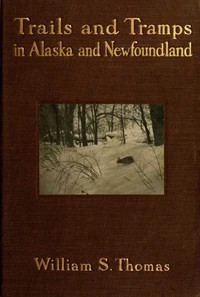
Before opening Trails and Tramps in Alaska and Newfoundland — Text and Context, the edition data offers a quick orientation: 57,507 words, 4 hr 11 min estimated reading time, and 10 detected text sections.
The text analysis averages about 25.4 words per sentence, while the detected sections provide another way to judge how the source is divided.
Project Gutenberg metadata also associates the work with “Birds,” connecting these edition facts with the source record’s subject description.
Explore this collection
These alternatives are selected using recorded categories and estimated reading time.
About 264 minutes
Geography
60,552 recorded words. 13 minutes difference from this book's estimate.
View Gutenberg source #58361About 236 minutes
Geography
54,227 recorded words. 15 minutes difference from this book's estimate.
View Gutenberg source #28506About 231 minutes
Geography
52,943 recorded words. 20 minutes difference from this book's estimate.
View Gutenberg source #4981Search stored excerpts and compare books → Choose by your preferences →
Choices use stored catalog measurements. Estimates vary with reading speed. A shared category is a catalog label, not a claim that two books have the same argument or literary quality.
Search reads excerpt text stored with this catalog and links to its associated Gutenberg record. The connection is stored in the site database; this tool does not recheck that every excerpt is word-for-word identical to that external record. Excerpt search does not cover every chapter and does not verify historical publication dates.
Catalog snapshot checked: 2026-09-25. Coverage: 95 public books, 95 available source excerpts.
Read the complete public-domain text at its original source.
Read on Project GutenbergWilliam S. Thomas's Trails and Tramps in Alaska and Newfoundland (1913) is structured as a series of discrete excursions rather than a continuous journey. The book's ten chapters alternate between extended Alaskan expeditions and shorter, more localized hunts, with the final chapter shifting to a plea for wildlife protection. This arrangement creates a rhythm of immersion and return, mirroring the author's own pattern of pilgrimage into and out of wilderness.
Throughout, Thomas frames his narrative through the lens of photography: the subtitle promises "Hunting Big Game with Gun and with Kodak," and the text repeatedly juxtaposes the hunter's rifle with the camera's viewfinder. This dual focus generates a distinctive tension between the desire to document and the impulse to pursue, a conflict that plays out in several key episodes.
The book's organization is geographical but not chronological. The first three chapters cover southeastern Alaska, Kodiak Island, and the Kenai Peninsula; the fourth moves to Newfoundland; the fifth and sixth return to shorter hunts (ferreting, night hunting); the seventh is a springtime miscellany; and the eighth is a conservation appeal. This back-and-forth between regions and modes prevents any single landscape from dominating. Thomas does not attempt a unified travelogue but instead presents each trip as a self-contained vignette, often beginning with the logistics of departure and ending with the return home. The effect is cumulative: the reader accumulates a sense of the varied terrains—coastal fjords, inland swamps, island meadows—without a linear plot. The preface confirms this, stating the material was "accumulated upon several hunting trips" over years, not a single expedition.
Thomas repeatedly treats his Kodak as a tool parallel to his gun. In one episode, he spots cow moose and initially reaches for his camera, only to set it down and raise his rifle when the animals approach too closely. The moment crystallizes the book's central ambiguity: is he a hunter or a naturalist? The photographs mentioned in the text—of totems, glaciers, native women, and game—are not merely illustrations but evidence of a systematic effort to capture what the gun cannot preserve. Yet Thomas also admits missed photographic opportunities, as when he regrets not returning to photograph bull moose. This self-criticism suggests that the camera imposes its own discipline, requiring patience and planning that the hunt does not always permit. The interplay between the two tools gives the narrative a reflective quality uncommon in pure hunting accounts.
Certain sensory details recur across chapters, binding the disparate locations. Thomas frequently describes light effects: the "northern splendor" of the aurora, the "full moon" that tricks him into mistaking it for a searchlight, and the "crystal water" of Alaskan streams. Water itself is a constant presence—ocean passages, lake crossings, rain that "patter, patter[s] on the stretched canvas." These elements create a sensory continuity that transcends geography. The author's attention to weather, especially rain, is notable: he notes "incessant" downpours and the relief of brief clearings, and he finds comfort in being "lulled into dreamland" by rain on canvas. Such details root the reader in the physical experience of the wilderness, where comfort is provisional and the environment is never neutral.
A striking motif is Thomas's discovery of traces of other people in remote places. On the Kenai Peninsula, he finds a camp recently used by a fellow townsman, George Shiras III, and notes the coincidence of their separate routes converging. Later, he encounters a well-worn moose path that he cannot explain until after returning home, when Shiras informs him it led to a salt lick. These moments underscore the book's interest in the human geography of wilderness: trails, camps, and cards left on trees become evidence of a network of travelers. Thomas does not present himself as a solitary explorer but as one participant in a community of sportsmen-naturalists who share knowledge across distances. The surprise of finding Shiras's card is described as "like receiving a letter from home," a reminder that even in the far North, connections persist.
Readers approaching Trails and Tramps should attend to the book's hybrid identity: it is neither a pure hunting manual nor a naturalist's journal, but a record of a sensibility caught between the two. Thomas's willingness to include missed shots, failed photographs, and unexplained phenomena gives the narrative an honesty that compensates for its episodic structure. The final chapter's plea for protection, while brief, reframes the earlier hunts as part of a larger concern for the future of the game and landscapes he describes.
It makes me think of my father’s old field notes, the way Thomas balances a photograph’s stillness against the sudden motion of pursuit. That same quiet tension lives in In the Oregon Country Out-Doors in Oregon, Washington, and California Together with some Legendary Lore, and Glimpses of the Modern West in the Making — Text and Context, where observation feels like a form of waiting—not hunting, but holding still long enough to see.
Create a short personal record of your experience with this book.