About 211 minutes
An American Girl in Munich: Impressions of a Music Student — Reading Companion
Geography
48,361 recorded words. 3 minutes difference from this book's estimate.
View Gutenberg source #46102
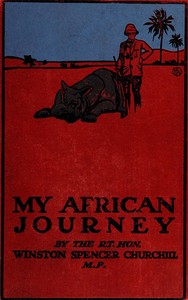
My African Journey — Key Ideas to Explore can be approached with a clearer sense of reading commitment from its source measurements: 49,129 words, 3 hr 34 min estimated reading time, and 7 detected text sections.
The text analysis averages about 25.2 words per sentence, while the detected sections provide another way to judge how the source is divided.
Project Gutenberg metadata also associates the work with “Africa, East -- Description and travel,” connecting these edition facts with the source record’s subject description.
Explore this collection
These alternatives are selected using recorded categories and estimated reading time.
About 211 minutes
Geography
48,361 recorded words. 3 minutes difference from this book's estimate.
View Gutenberg source #46102About 219 minutes
Geography
50,262 recorded words. 5 minutes difference from this book's estimate.
View Gutenberg source #52528About 205 minutes
Geography
47,058 recorded words. 9 minutes difference from this book's estimate.
View Gutenberg source #28562Search stored excerpts and compare books → Choose by your preferences →
Choices use stored catalog measurements. Estimates vary with reading speed. A shared category is a catalog label, not a claim that two books have the same argument or literary quality.
Search reads excerpt text stored with this catalog and links to its associated Gutenberg record. The connection is stored in the site database; this tool does not recheck that every excerpt is word-for-word identical to that external record. Excerpt search does not cover every chapter and does not verify historical publication dates.
Catalog snapshot checked: 2026-09-25. Coverage: 95 public books, 95 available source excerpts.
Read the complete public-domain text at its original source.
Read on Project GutenbergChurchill's preface frames My African Journey as an effort to 'vivify and fortify the interest of the British people' in recently acquired East African territories. The catalog subjects—East Africa, Uganda, and the Nile Valley—accurately reflect the itinerary, but the excerpts show that Churchill's attention is less on scenic description and more on the mechanics of colonial development: railways, water-power, and administrative centers. The text repeatedly evaluates locations by their economic potential, as when he notes that Jinja 'is destined to become a very important place' due to its water-power and transport links. This utilitarian lens, rather than pure travelogue, shapes the narrative.
Churchill's observations consistently return to engineering and commerce. At the Ripon Falls, he calculates that 'two or three short dams' could raise the lake level and increase water-power, enabling steamers of larger draught. The Uganda Railway is not merely a means of travel but a subject of analysis: he rides on the cow-catcher, photographs breakdowns, and notes the 'full tale of steamers' (with a transcriber's query about the phrase). Even the rescue of a 'poor coolie' who slips into crocodile-infested waters is framed as an example of British conduct, with the officer's act receiving recognition from the Royal Humane Society. The catalog subject 'Churchill, Winston — Travel — Africa' is thus only partly accurate; the book is equally about the technological and administrative apparatus of empire.
Churchill explicitly critiques the name 'Jinja,' calling it 'a pity to handicap the town with an outlandish name' and proposing 'Ripon Falls' instead. This moment reveals a colonial impulse to rename and reorder. The catalog subjects list 'Uganda — Description and travel' and 'Nile River Valley — Description and travel,' but the excerpts show that description is never neutral: Churchill sees Jinja as a future 'emporium of tropical produce' with 'comfortable tropical villas and imposing offices.' The landscape is evaluated for its utility to British enterprise, and local names are treated as provisional. The text's own structure—chapters titled 'The Uganda Railway,' 'The Highlands of East Africa,' 'The Kingdom of Uganda'—mirrors this administrative categorization of space.
Despite the catalog subject 'Africa, East — Description and travel,' the excerpts offer little description of African societies. Africans appear mainly as laborers (the coolie), as crowds at receptions ('local chiefs and Indian traders'), or as subjects of rescue. Churchill notes that the islands of Lake Victoria are 'all depopulated by sleeping sickness,' but the disease is mentioned without further comment. The 'Kavirondo warriors' and 'Nandi and Kavirondo warriors' appear only in photograph captions. The text's focus remains on British officials, settlers, and infrastructure. Readers expecting ethnographic detail will find instead a narrative centered on the traveller's own perceptions and the colonial apparatus he represents.
Churchill's journey is best approached as a document of Edwardian imperial thought rather than a travel guide. The catalog subjects are accurate but incomplete: the book is as much about hydroelectric potential and railway logistics as about landscapes. Readers interested in the intersection of personal observation and policy advocacy will find the preface and the Jinja passages particularly revealing. The photographs—taken by Churchill and Lieutenant-Colonel Gordon Wilson—offer a visual counterpart to the text's emphasis on infrastructure and control.
There’s something touching about how Churchill’s journeys were so bound up with maps and ambitions, the land itself almost secondary. I sometimes feel that same wistfulness reading older travel accounts, where the impulse to catalogue meets a quieter wonder. That old A Tour to the River Saguenay, in Lower Canada — Key Ideas to Explore has a similar ache, a sense of places measured yet still mysteriously themselves.
A brief reflection can help important ideas stay with you longer.