About 81 minutes
The Scott Country — Background and Themes
Geography
18,437 recorded words. 10 minutes difference from this book's estimate.
View Gutenberg source #52345
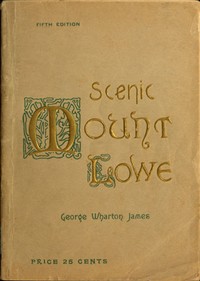
For Scenic Mount Lowe and Its Wonderful Railway — Story, Setting & Ideas, the stored edition analysis reports 20,896 words, 1 hr 31 min estimated reading time, and 4 detected text sections.
The text analysis averages about 23.2 words per sentence, while the detected sections provide another way to judge how the source is divided.
Project Gutenberg metadata also associates the work with “California -- Description and travel,” connecting these edition facts with the source record’s subject description.
Explore this collection
These alternatives are selected using recorded categories and estimated reading time.
About 81 minutes
Geography
18,437 recorded words. 10 minutes difference from this book's estimate.
View Gutenberg source #52345About 72 minutes
Geography
16,408 recorded words. 19 minutes difference from this book's estimate.
View Gutenberg source #4247About 112 minutes
Geography
25,653 recorded words. 21 minutes difference from this book's estimate.
View Gutenberg source #5809Search stored excerpts and compare books → Choose by your preferences →
Choices use stored catalog measurements. Estimates vary with reading speed. A shared category is a catalog label, not a claim that two books have the same argument or literary quality.
Search reads excerpt text stored with this catalog and links to its associated Gutenberg record. The connection is stored in the site database; this tool does not recheck that every excerpt is word-for-word identical to that external record. Excerpt search does not cover every chapter and does not verify historical publication dates.
Catalog snapshot checked: 2026-09-25. Coverage: 95 public books, 95 available source excerpts.
Read the complete public-domain text at its original source.
Read on Project GutenbergThe book opens with a poem by Longfellow, setting a tone of reverence for mountains before launching into a detailed account of the Mount Lowe Railway. Author George Wharton James, a prolific writer on the American West, frames the railway as both a marvel of electric engineering and a gateway to sublime natural beauty. The table of contents reveals a structure that moves from the railway's origin and technical features—such as the Great Cable Incline and Circular Bridge—to the scenic and health benefits of mountain climbing. James interweaves promotional material for the Pacific Electric Railway with his own descriptive prose, making clear that this is as much an advertisement as a travelogue.
James devotes considerable space to the mechanical ingenuity of the Mount Lowe Railway, describing how electric cars surmounted the Sierra Madre mountains. He details the Great Cable Incline, the operating machinery, and the Circular Bridge, presenting these not merely as functional elements but as attractions in their own right. The railway is called "the Grandest Railway in the World," a claim supported by descriptions of its steep grades and the engineering challenges overcome. James emphasizes that the line was built to fit the mountain, not the other way around, quoting Professor Lowe's modest account of his work. This section grounds the reader in the physical reality of the railway before moving to its scenic rewards.
The book repeatedly returns to the panoramic views accessible from various points along the line: Echo Mountain, Inspiration Point, and the Alpine Tavern. James catalogs the sights visible from Mount Lowe, including the Pacific Ocean, the Channel Islands, and the surrounding valleys. He uses phrases like "a view such as can be had from no other spot on the wide globe" to convey the uniqueness of the perspective. The descriptions are vivid but generic, focusing on the sweep of scenery rather than specific landmarks. Readers should note that James often prioritizes emotional impact over precise geography, using the views as evidence of the railway's value.
A significant portion of the text argues for the physical and mental benefits of mountain climbing. James claims that reduced atmospheric pressure at higher altitudes improves lung function, heart health, and mental clarity. He extends this to spiritual and aesthetic development, suggesting that mountains provide material for artists, poets, and orators. The prose becomes almost instructional, advising readers on how to experience these benefits. This section reveals James's broader agenda: promoting mountain tourism as a form of self-improvement. The health claims are presented as fact, without scientific citation, reflecting the era's enthusiasm for altitude therapy.
James includes chapters on the flora of Mount Lowe and the contrast between alpine snow and semi-tropical sea. He notes the variety of plant life at different elevations, from flowers near Echo Mountain House to snow at the summit. The seasonal cycle is highlighted, with winter described as a time of beauty rather than hardship. These passages are less detailed than the engineering sections, but they reinforce the idea of the mountain as a complete environment. The inclusion of a chapter on "Coast Islands from Mount Lowe" suggests that the view itself is a form of natural history, connecting the mountain to the broader landscape of Southern California.
Readers approaching this book should treat it as a period piece that blends boosterism with genuine wonder. James's enthusiasm is infectious, but his claims should be weighed against the promotional context. The excerpts provide a clear sense of the railway's route and the author's rhetorical strategies, though the complete work likely includes more detailed descriptions of specific locations. For a first reading, focus on how James uses technical detail to support his aesthetic arguments, and note the interplay between commerce and nature that defines the text.
There’s something achingly tender about old railway books—how they preserve a landscape that’s slipped away. That same quiet ache returns in A Tour to the River Saguenay, in Lower Canada — Key Ideas to Explore, where mountain and river hold their silence the way Mount Lowe’s echo does. I suppose we’re all just tracing fading paths, hoping the view remembers us too.
Use these questions to collect your thoughts before moving on.