Julia Cartwright's The Pilgrims' Way from Winchester to Canterbury (1911) is a revised edition of a text first published in 1893. The preface notes that 'a whole literature has grown up round the Pilgrims' Way' in the intervening years, and Cartwright explicitly acknowledges the work of H. Snowden-Ward, Mr. Palmer, F. Elliston-Erwood, and especially Hilaire Belloc, whose 'The Old Road' traced the route 'yard by yard from the capital of Hampshire to the capital of Kent.' Cartwright's own account, originally serialized in the Art Journal, combines a walker's observations with historical digressions drawn from archival sources and local histories.
The catalog subjects list 'England -- Description and travel' and 'Christian pilgrims and pilgrimages' as primary categories, but the excerpts reveal a work more concerned with secular topography and manorial history than with devotional practice. The pilgrims themselves are a framing device rather than a sustained focus; the text dwells on battlefields, manor houses, and the architectural remains of episcopal palaces.
Topography and the Chalk Ridge
Cartwright's descriptive passages emphasize the physical landscape as the constant companion of the traveller. In the Kentish section, she writes of 'steep slopes and wooded hollows, these grand old church towers and quaint village streets' and notes that 'all along our way we have that noble prospect over the wide plains of the dim blue Weald, which is seldom absent from our eyes.' The route follows the chalk hills that form 'the backbone of Kent,' and the author repeatedly draws attention to the narrow track 'up and down the rugged hill-side.' This persistent attention to the ridgeway's elevation and views suggests that the book functions partly as a walking guide, alert to the physical demands and rewards of the path.
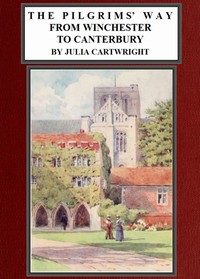
The illustrations by A. H. Hallam Murray, mentioned in the preface as a new addition to this edition, presumably complement these topographical descriptions, though the excerpts do not include image captions. The text's structure—moving from Winchester eastward through Surrey into Kent—mirrors the pilgrim's progress, but Cartwright's eye is as much on the modern landscape as on its medieval associations.
Historical Digressions and Manorial Records
The excerpts show that Cartwright frequently pauses the narrative of the journey to recount the history of specific sites. The treatment of Otford, an Archbishop's manor, is typical: she traces its grant to the See of Canterbury in 791 by Offa, king of Mercia, notes a battle in 773, and then jumps to the eleventh century when 'Edmund Ironside defeated the Danes under Knut.' The description of the palace's fate after the Reformation—'passed into the hands of the Sydneys and Smyths, who dismantled the castle'—is given in considerable detail, including the reuse of stone in the Bull Inn and the survival of 'two heads in profile, carved in oak' said to represent Henry VIII and Katherine of Aragon.
These digressions rely on printed sources such as Hasted's county history and the Domesday Survey, which Cartwright cites explicitly. The effect is a layered text that moves between present-day observation and antiquarian reconstruction, often without clear transition. The catalog subject 'Roads -- England' captures the physical route, but the book's content is more accurately described as a series of local histories linked by the path of the Way.
The Pilgrim as a Rhetorical Figure
Despite the title, the actual medieval pilgrim appears infrequently in the excerpts. Cartwright uses the pilgrim as a structuring device—'the first resting-place which the pilgrims would find'—but the historical details she provides are about archbishops, kings, and manorial administration rather than about the experience of pilgrimage itself. The preface acknowledges that other works have dealt 'at length with the life and death, the cult and miracles of St. Thomas,' implying that Cartwright's book deliberately avoids that territory.
Instead, the pilgrim functions as a hypothetical traveller whose itinerary justifies the author's selection of sites. The phrase 'the traveller will find as he follows the Pilgrims’ Way' suggests that the intended reader is a modern walker or cyclist, not a historian of religion. The catalog subject 'Christian pilgrims and pilgrimages' is therefore somewhat misleading; the book is a topographical and antiquarian guide that uses the pilgrimage route as its organizing principle, not as its subject.
Readers approaching this book should expect a leisurely, erudite travelogue rather than a focused study of pilgrimage. Cartwright's prose is dense with proper names and dates, and she assumes familiarity with English ecclesiastical and manorial history. The illustrations by Hallam Murray are an integral part of the edition, though the text can stand alone. For those interested in the physical route, Belloc's The Old Road (cited in the preface) offers a more systematic reconstruction; Cartwright's value lies in the accumulation of local detail and the evocation of a landscape layered with centuries of use.
There’s a particular ache in following Julia Cartwright’s chalk ridge, knowing the shrines she describes have mostly faded into farmland. It reminds me of leafing through Austin Henry Layard’s Discoveries Among the Ruins of Nineveh and Babylon — Reading Notes, where every mound holds a vanished empire. Both feel like listening to someone describe a place they loved, knowing we’ll never quite see it the same way.