About 547 minutes
The History of the Great and Mighty Kingdom of China and the Situation Thereof, Volume 2 (of 2) — Text and Context
Geography
125,718 recorded words. 9 minutes difference from this book's estimate.
View Gutenberg source #42551
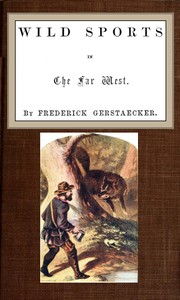
The source record for Wild Sports in the Far West — Reading Notes measures this digital text at 123,519 words, 8 hr 58 min estimated reading time, and 11 detected text sections.
The text analysis averages about 28.4 words per sentence, while the detected sections provide another way to judge how the source is divided.
Project Gutenberg metadata also associates the work with “United States -- Description and travel,” connecting these edition facts with the source record’s subject description.
Explore this collection
These alternatives are selected using recorded categories and estimated reading time.
About 547 minutes
Geography
125,718 recorded words. 9 minutes difference from this book's estimate.
View Gutenberg source #42551About 517 minutes
Geography
118,841 recorded words. 21 minutes difference from this book's estimate.
View Gutenberg source #68958About 561 minutes
Geography
128,870 recorded words. 23 minutes difference from this book's estimate.
View Gutenberg source #42090Search stored excerpts and compare books → Choose by your preferences →
Choices use stored catalog measurements. Estimates vary with reading speed. A shared category is a catalog label, not a claim that two books have the same argument or literary quality.
Search reads excerpt text stored with this catalog and links to its associated Gutenberg record. The connection is stored in the site database; this tool does not recheck that every excerpt is word-for-word identical to that external record. Excerpt search does not cover every chapter and does not verify historical publication dates.
Catalog snapshot checked: 2026-09-25. Coverage: 95 public books, 95 available source excerpts.
Read the complete public-domain text at its original source.
Read on Project GutenbergFriedrich Gerstäcker’s Wild Sports in the Far West opens not with a grand adventure but with a confession: the author never intended to publish his diary. The preface frames the work as a private record, revised only after extracts met with interest. This origin shapes the book’s voice—direct, unpolished, and grounded in the specific rather than the heroic. Gerstäcker warns that readers expecting “glowing descriptions of riches and plenty” will be disappointed. Instead, he offers a counter-narrative: the emigrant’s solitude, the hunter’s empty stomach, and the laborer’s raw hands. The prose is tactile, attentive to the weight of an axe or the thickness of a cane reed. Even the illustrations, by Harrison Weir, are described as “crayon drawings” executed in oil colors—a hybrid technique that mirrors the book’s blend of travelogue, memoir, and natural history.
Gerstäcker’s preface is unusually candid about the book’s construction. He describes writing out his diary “in detail as an employment for my leisure hours” for his family in Germany, then later “correct[ing] and revis[ing]” the notes into a continuous narrative. This process leaves visible seams: the text shifts between immediate, diary-like observations and more reflective passages. The author admits he recorded only “circumstances worthy of being chronicled,” which means the narrative is selective, not exhaustive. Readers encounter a curated version of his travels, one that prioritizes incident over chronology. The preface also establishes a skeptical tone toward the very genre the book belongs to. Gerstäcker warns the “inveterate sportsman” that the reality of hunting in the West—wet, hungry, alone, plagued by mosquitoes—may feel like a myth. This self-awareness distinguishes the book from more boosterish accounts of the frontier.
One of the most striking passages in the excerpts describes Gerstäcker’s work cutting wood near Memphis. He specifies the dimensions of a cord—“eight feet long, four feet high, and four feet deep”—and notes that with “weak health and unpractised hand” he could manage one cord per day. The physical detail is precise, almost technical. Later, he recounts making pill-boxes and pounding chocolate in an iron mortar, then cutting cane for pipe-stems. These episodes are not asides; they form the core of the narrative. Gerstäcker presents labor as the emigrant’s primary reality. He is cheated by a merchant who gives him “bad coin,” and he observes whole families of Germans in Cincinnati “ready to do any thing for bare food.” The voice is matter-of-fact, neither sentimental nor indignant. The effect is to ground the “wild sports” of the title in the mundane struggle for survival.
Gerstäcker, a German traveler, frequently notes details that a native writer might omit. He describes the Mississippi’s banks as “high and steep” at Memphis, so that the town “cannot be seen from the stream.” He observes wharf-boats “formed of used-up steamboats moored to the banks.” These observations carry the freshness of a newcomer. The landscape is not a backdrop for adventure but a practical environment to be navigated. The cane thickets where he cuts pipe-stems are “immense” and grow on riverbanks “among the snakes and mosquitoes.” The author’s attention to the physical texture of places—the height of a bank, the thickness of a reed—gives the prose a documentary quality. He is less interested in picturesque vistas than in usable terrain. This perspective aligns with the book’s stated aim: to portray “the social condition of the Americans” as it actually appeared to a foreign observer.
Despite the title’s promise of “wild sports,” the excerpts depict hunting as a marginal activity, often unsuccessful. Gerstäcker mentions following deer tracks “for days together, without the chance of a single shot.” The preface even suggests that the tales of hunting in the West may be “myths existing only in the brains of the Indians.” This deflation of expectation is deliberate. The author positions himself as a realist, wary of the romanticism that drew emigrants westward. When he does describe hunting, the focus is on the physical toll: the wet clothes, the loneliness, the longing for fire and company. The book’s illustrations, by Harrison Weir, may have depicted dramatic scenes, but the text itself is more ambivalent. Gerstäcker’s hunter is often tired, hungry, and far from home. The “wild sports” are real, but they are also work.
Gerstäcker’s narrative resists easy categorization. It is part travelogue, part memoir, part natural history, and part economic report. Readers will find no single plot but a series of episodes linked by the author’s voice—curious, wry, and unflinching. The book rewards attention to its small details: the price of a cord of wood, the color of a pill-box, the thickness of a cane reed. These specifics anchor the story in a particular time and place. For those interested in the texture of everyday life on the antebellum frontier, Wild Sports in the Far West offers a rare, unvarnished view.
Gerstäcker knew the ache of empty hands and muddy trails, yet he always noted the light on a lake or the call of a bird. That same steady patience lives in The Mountains of Oregon — Reading Notes, where hardship sits beside quiet wonder. They share a gentle honesty, like old friends nodding across a reading room.
Use these questions to collect your thoughts before moving on.