James's Account of S. H. Long's Expedition, 1819-1820, part 4 — Themes and Context
Edition facts
This digital edition of James's Account of S. H. Long's Expedition, 1819-1820, part 4 — Themes and Context is described by source-level measurements including 92,074 words, 6 hr 41 min estimated reading time, and 18 detected text sections.
The text analysis averages about 22.2 words per sentence, while the detected sections provide another way to judge how the source is divided.
Project Gutenberg metadata also associates the work with “Indians of North America,” connecting these edition facts with the source record’s subject description.
Read the complete public-domain text at its original source.
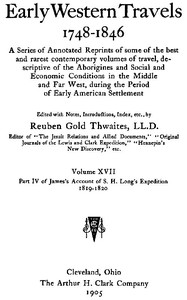
Read on Project GutenbergThis volume reprints Part IV of Edwin James's account of Major Stephen H. Long's 1819-1820 expedition to the Rocky Mountains, originally published in 1823. The text combines travel narrative with scientific appendices: a general description of the country traversed, geological observations by Augustus Edward Jessup, astronomical calculations by Long and William Henry Swift, and vocabularies of Indian languages collected by Thomas Say. The excerpts show that the work is as much a commentary on the limits of ethnographic knowledge as it is a record of exploration.
Ethnographic Skepticism
The excerpt on Indian character is notably cautious. The author warns that “the delicate trains of thought and reflection attributed to them by writers who have attempted to enlarge our acquaintance with the Indian character, usually have their origin in the ingenuity of the writers themselves.” This directly challenges romanticized portrayals common in earlier travel literature. The text insists that reliable information about abstract or metaphysical ideas is nearly impossible to obtain because interpreters are often unable to “converse intelligently” on such subjects. The author further notes that Indians are “either ignorant or wilfully silent” regarding population numbers and individual ages, deeming such inquiries “impertinent curiosity.” These statements frame the ethnographic sections as provisional and self-aware, not authoritative.
Structure and Scientific Apparatus
The volume is organized into three narrative chapters (IX–XI) followed by several scientific reports. Chapter IX covers the journey from Belle Point to Cape Girardeau, with observations on Cherokee Indians and the Osage War. Chapter X describes the Hot Springs of the Washita and the granite of the Cove. Chapter XI treats the Red River and the exploring expedition of 1806. The appendices include a “General Description of the Country” by Long, “Observations on the Mineralogy and Geology” by Jessup, and “Calculations of Observations” by Long and Swift. The inclusion of Thomas Say's “Vocabularies of Indian Languages” underscores the expedition's linguistic interests. This hybrid structure—narrative travelogue paired with specialized reports—reflects the era's expectation that exploring expeditions produce both popular accounts and scientific data.
Observations on Indian Governance and Society
The excerpt describes secret councils, called “medicine, or rather magic feasts,” where only principal men or those who have distinguished themselves in battle, hunting, or horse-stealing are admitted. These councils discuss war, peace, and national interests with “the greatest solemnity,” and decisions are proclaimed to the people by criers who explain the reasoning. The text also notes that men engage in hunting, warfare, and horse-tending, while women perform cultivation, fuel-gathering, and domestic work—a division the author presents without overt judgment but as a matter of fact. The description of religion emphasizes rites, ceremonies, singing, and dancing believed to heal the sick and frustrate enemies. These observations, though filtered through the author's perspective, provide specific details about social organization and ritual life.
Readers should approach this volume as a layered document: the narrative chapters offer a chronological account of the expedition's route and encounters, while the scientific appendices reveal the intellectual frameworks of early nineteenth-century American exploration. The ethnographic passages are best read with attention to their stated limitations, as the author repeatedly acknowledges the difficulty of obtaining reliable information. The vocabularies and geological notes provide primary data that reward close study.
Reading about Long’s men pausing to marvel at the Hot Springs, I remembered a wet afternoon with The Romance of the Colorado River — Background and Themes, how both books share that ache of hoping a place will mean more than the map says. Their lists of rocks and vocabularies feel like hands reaching for something they couldn’t quite hold.

There are no reviews for this eBook.
Before you leave, reflect on the book
Use these questions to collect your thoughts before moving on.