About 401 minutes
James's Account of S. H. Long's Expedition, 1819-1820, part 4 — Themes and Context
Exploration
92,074 recorded words. 83 minutes difference from this book's estimate.
View Gutenberg source #48481
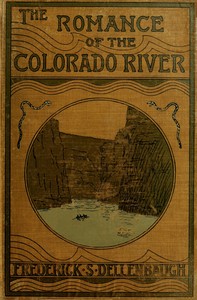
The source record for The Romance of the Colorado River — Background and Themes measures this digital text at 111,191 words, 8 hr 4 min estimated reading time, and 20 detected text sections.
The text analysis averages about 20.1 words per sentence, while the detected sections provide another way to judge how the source is divided.
Project Gutenberg metadata also associates the work with “Grand Canyon (Ariz.) -- Description and travel,” connecting these edition facts with the source record’s subject description.
Explore this collection
These alternatives are selected using recorded categories and estimated reading time.
About 401 minutes
Exploration
92,074 recorded words. 83 minutes difference from this book's estimate.
View Gutenberg source #48481About 359 minutes
Exploration
82,440 recorded words. 125 minutes difference from this book's estimate.
View Gutenberg source #35658About 252 minutes
Exploration
57,890 recorded words. 232 minutes difference from this book's estimate.
View Gutenberg source #4521Search stored excerpts and compare books → Choose by your preferences →
Choices use stored catalog measurements. Estimates vary with reading speed. A shared category is a catalog label, not a claim that two books have the same argument or literary quality.
Search reads excerpt text stored with this catalog and links to its associated Gutenberg record. The connection is stored in the site database; this tool does not recheck that every excerpt is word-for-word identical to that external record. Excerpt search does not cover every chapter and does not verify historical publication dates.
Catalog snapshot checked: 2026-09-25. Coverage: 95 public books, 95 available source excerpts.
Read the complete public-domain text at its original source.
Read on Project GutenbergFrederick S. Dellenbaugh, who served on the 1871-1872 Colorado River Expedition, opens this account not with his own journey but with the earliest recorded encounters: the 1539 voyage of Ulloa and Alarcón's 1540 ascent of the river. The book's subtitle promises “special reference to the voyages of Powell,” yet the first seven chapters cover Spanish explorers, trappers, and the failed Ives expedition before reaching Powell. This structure signals that Dellenbaugh intends to place Powell's achievements within a long history of partial discoveries and near-misses.
The excerpts reveal a narrator who values precise detail—he notes the exact number of leagues Alarcón ascended, the specific trees used for oar-timber, and the barometric calculations that gauged the river's descent. Readers should expect a methodical, evidence-based style rather than romantic embellishment, despite the title's word “Romance.”
Dellenbaugh writes as an insider. He was there during the second Powell expedition, and his dedication “to my friends and comrades of the Colorado River Expedition of 1871 and 1872” establishes personal stakes. This vantage shapes his narrative: he can describe the making of cottonwood oars, the collection of pinyon gum for caulking, and the precise locations where photographs were taken (e.g., “The Craggs at Millecrag Bend”). His account of the false report of Powell's death—circulated by a man who “by ‘pitching’ this picturesque yarn, secured the sympathy and the purses of the passengers”—carries the authority of someone who knew the actual events. Yet he does not overstate his own role; the focus remains on Powell and the river.
The excerpts emphasize the Colorado's physical challenges: “roaring rapids,” “capsizes and catastrophes,” and the constant threat of a “high fall where no footing on either side could be obtained.” Dellenbaugh treats the river as a problem to be solved through observation and calculation. When Powell's party examines the barometric record, they estimate the remaining descent and weigh the possibility of “concentrated great plunges.” This analytical approach contrasts with the more sensational accounts of the time. The narrative also includes quiet moments—the “Music Temple Alcove” where the men sang, and the carving of names by those later killed—that humanize the expedition without diminishing its scientific purpose.
Dellenbaugh devotes notable space to a false story that Powell's entire party except one man had been swallowed by a whirlpool in Brown's Hole. He dissects the fabrication: the inventor named the wrong location, and Mrs. Powell, knowing Brown's Hole was “the quietest on the whole course,” dismissed the tale. The anecdote reveals how public imagination shaped the expedition's reputation—and how Dellenbaugh, as a participant, corrects the record. This concern with accuracy extends to his treatment of earlier explorers: he calls James White's story a “masterful fabrication” and carefully distinguishes verified discoveries from legends. The reader is thus guided to trust Dellenbaugh's account over more dramatic but less reliable sources.
The excerpts include references to photographs by E.O. Beaman and a water-color sketch by Thomas Moran, indicating that Dellenbaugh values visual documentation. He describes the Grand Canyon's depth as “some 6000 feet” and notes wall heights rising from 1300 to 1800 feet. These numbers ground the narrative in measurable reality. The photographs—of Millecrag Bend, the Music Temple Alcove—serve as checkpoints for the reader, linking text to specific locations. Dellenbaugh's own membership in the expedition gives him access to such records, and he uses them to reinforce the credibility of his account. Readers should note that the book's illustrations are integral to its argument, not mere decoration.
Dellenbaugh's dual role as historian and participant makes The Romance of the Colorado River a valuable corrective to more sensationalized accounts. Readers will benefit from paying attention to the footnotes, photographs, and appendices, which often contain details that challenge popular myths. The book rewards those who read it as a layered work—part adventure story, part scientific report, part memoir—and who approach its claims with the same critical eye Dellenbaugh applies to his predecessors.
That rainy afternoon, Dellenbaugh’s voice made the canyon feel like a living presence, patient and indifferent. Later, I found myself puzzling over how explorers carry their own weather inside them, so I reached for the quiet, meticulous logs of another survey voyage, the Narrative of the surveying voyages of His Majesty's ships Adventure and Beagle, between the years 1826 and 1836. Volume I. Proceedings of the First Expedition, 1826-1830 — Reading Notes, and found the same patient tide of observation.
Create a short personal record of your experience with this book.