About 233 minutes
Voyages in Search of the North-West Passage — Reading Notes
Exploration
53,451 recorded words. 38 minutes difference from this book's estimate.
View Gutenberg source #3482

The River and I — Context and Discussion can be approached with a clearer sense of reading commitment from its source measurements: 44,703 words, 3 hr 15 min estimated reading time, and 6 detected text sections.
The text analysis averages about 16.8 words per sentence, while the detected sections provide another way to judge how the source is divided.
Project Gutenberg metadata also associates the work with “Missouri River -- Description and travel,” connecting these edition facts with the source record’s subject description.
Explore this collection
These alternatives are selected using recorded categories and estimated reading time.
About 233 minutes
Exploration
53,451 recorded words. 38 minutes difference from this book's estimate.
View Gutenberg source #3482About 252 minutes
Exploration
57,890 recorded words. 57 minutes difference from this book's estimate.
View Gutenberg source #4521About 359 minutes
Exploration
82,440 recorded words. 164 minutes difference from this book's estimate.
View Gutenberg source #35658Search stored excerpts and compare books → Choose by your preferences →
Choices use stored catalog measurements. Estimates vary with reading speed. A shared category is a catalog label, not a claim that two books have the same argument or literary quality.
Search reads excerpt text stored with this catalog and links to its associated Gutenberg record. The connection is stored in the site database; this tool does not recheck that every excerpt is word-for-word identical to that external record. Excerpt search does not cover every chapter and does not verify historical publication dates.
Catalog snapshot checked: 2026-09-25. Coverage: 95 public books, 95 available source excerpts.
Read the complete public-domain text at its original source.
Read on Project GutenbergNeihardt opens his account of a 1908 river voyage with a wry comparison: the Missouri River, he suggests, is like a great work that produces an unpleasant first impression—a nod to Carlyle that sets the tone for a narrative unafraid of discomfort. The author and his companions, identified only as Bill and the Kid, navigate the Upper Missouri and Yellowstone in a light, springy boat they call the Atom, powered by a temperamental engine that "barked spitefully" and threatened to quit. Their journey is marked by precise, often humorous observations of rapids, mechanical failures, and the river's shifting moods, as when they strike a submerged boulder at Dauphin Rapids, launching the boat skyward and losing their bacon. Neihardt's prose is lean and concrete, favoring the specific over the picturesque.
The boat itself becomes a character in Neihardt's narrative. Named the Atom, it is described as "light springy tough"—a craft built to flex rather than break. When the boat strikes a smooth boulder at Dauphin Rapids, Neihardt notes that a vessel with "ordinary launch construction would have opened at every seam." The engine, a one-cylinder affair, is equally temperamental: it "began to show unmistakable signs of getting tired of its job," barking, wheezing, and running erratically. Yet it keeps the screw humming until the moment of impact, when Neihardt instinctively strikes the spark lever to silence its "howling like seven devils." These mechanical details are not mere technicalities; they anchor the adventure in the tangible reality of early twentieth-century river travel, where a broken engine meant drifting helplessly—and losing the bacon.
Neihardt's voice is consistently wry, even when describing near-calamities. After the Atom leaps the boulder, the crew "laughed loud and long" before discovering their bacon and oars are gone. The Kid proposes driving a stake in the bank to see if they are moving upstream or down. Later, they "talked about meat" with "devilish persistence" while drifting in the blistering sun. This humor is not forced; it emerges from the gap between expectation and reality—the grand adventure reduced to a hunger for bacon. Neihardt calls the incident a "purple spot," a phrase that suggests both a highlight and a bruise. The laughter is genuine, but it does not erase the seriousness of being stranded miles from supplies with a dead engine.
The Missouri River in these excerpts is not a backdrop but an active, almost sentient force. Neihardt describes its "heavy swells" on a windless day, the "almost noiseless rolling of the swift flood" at Dauphin, and the "pink flash" of a submerged rock just before impact. He notes the river's ability to inspire awe: the first sight of Eagle Rapids turned him "a bit gray inside." Yet the river is also a practical challenge—its shallows require "walking" boats over them, and its rapids demand constant attention to rudder and engine. Neihardt's observations are precise: the channel at Dauphin is narrow, no rocks appear above the surface, but speed is there. This is a river measured in miles per hour and inches of draft, not in romantic metaphors.
Readers approaching The River and I should expect a narrative that values accuracy over embellishment. Neihardt's account is grounded in the physical details of boat construction, engine mechanics, and river geography, leavened by a dry humor that never undercuts the genuine danger. The excerpts suggest a work that rewards attention to the specific—the weight of a grub box, the angle of a boat's rise, the sound of a failing engine—rather than to grand themes. This is a book best read with a map of the Missouri at hand and an appreciation for the kind of adventure that loses the bacon.
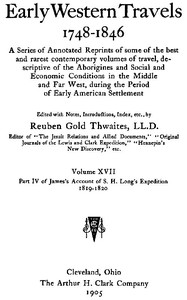
Reading Neihardt’s diary-like night on the Missouri, I kept thinking how much the river has changed—and how little. When he pauses to marvel at a sandbar’s quiet shift, I recall Edwin James, decades earlier, noting the same restless water with the same patient awe. Their James's Account of S. H. Long's Expedition, 1819-1820, part 4 — Themes and Context feels like a distant echo, one I was glad to revisit slowly.
Your answers remain private and are stored only in this browser.