About 233 minutes
Voyages in Search of the North-West Passage — Reading Notes
Exploration
53,451 recorded words. 19 minutes difference from this book's estimate.
View Gutenberg source #3482
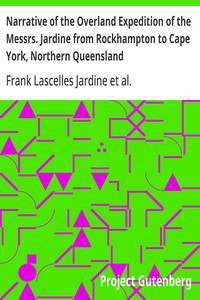
The source record for Narrative of the Overland Expedition of the Messrs. Jardine from Rockhampton to Cape York, Northern Queensland — A Closer Reading measures this digital text at 57,890 words, 4 hr 12 min estimated reading time, and 5 detected text sections.
The text analysis averages about 24.0 words per sentence, while the detected sections provide another way to judge how the source is divided.
Project Gutenberg metadata also associates the work with “Queensland -- Discovery and exploration,” connecting these edition facts with the source record’s subject description.
Explore this collection
These alternatives are selected using recorded categories and estimated reading time.
About 233 minutes
Exploration
53,451 recorded words. 19 minutes difference from this book's estimate.
View Gutenberg source #3482About 195 minutes
Exploration
44,703 recorded words. 57 minutes difference from this book's estimate.
View Gutenberg source #16793About 359 minutes
Exploration
82,440 recorded words. 107 minutes difference from this book's estimate.
View Gutenberg source #35658Search stored excerpts and compare books → Choose by your preferences →
Choices use stored catalog measurements. Estimates vary with reading speed. A shared category is a catalog label, not a claim that two books have the same argument or literary quality.
Search reads excerpt text stored with this catalog and links to its associated Gutenberg record. The connection is stored in the site database; this tool does not recheck that every excerpt is word-for-word identical to that external record. Excerpt search does not cover every chapter and does not verify historical publication dates.
Catalog snapshot checked: 2026-09-25. Coverage: 95 public books, 95 available source excerpts.
Read the complete public-domain text at its original source.
Read on Project GutenbergFrederick J. Byerley's 1867 compilation of the Jardine brothers' journals presents an expedition that succeeded in driving cattle overland to Cape York, yet the editor's preface immediately notes that its very success prevented public attention—a striking inversion of the usual pattern where disaster draws notice. The narrative is framed not as a heroic saga but as a practical solution to a supply problem: getting fresh meat to the Somerset settlement. Byerley, an Engineer of Roads, brings a bureaucratic precision to the account, while the brothers' own entries reveal a world of constant, unglamorous struggle against terrain, weather, and poison.
Byerley's preface sets the expedition in context: the rapid growth of Northern Australia and the need to supply Cape York. He explicitly contrasts the Jardines' journey with that of the 'unfortunate, but no less gallant predecessor, Kennedy,' whose disastrous end earned fame. The editor's tone is matter-of-fact, almost apologetic, as he notes that the journey 'has solved the question hitherto undecided of the course of the northern rivers' and determined how little of the York Peninsula is suitable for pastoral use. This framing emphasizes utility over adventure, a theme that persists throughout the compiled journals.
The excerpts reveal a relentless attrition of the expedition's horses, described with clinical detail. At Camp LXVII, five horses die from poisoning, with symptoms recorded precisely: 'Profuse sweating, with a heaving of the flanks, the ears droop, the eyes glaze, set, and the animal finally turns stone blind.' The leader's diary entry for that day closes with 'Nil Desperandum' and the parenthetical note 'Black Thursday.' The loss forces the party to abandon baggage, burying 25 sets of horseshoes and other gear in a cache marked with a shield and the inscription 'F J over LXVII. over DIG in heart.' The contrast between the stoic motto and the grim reality of digging a cache is characteristic of the narrative's understated tone.
Crossing a creek, the party loses two horses to a 'tangle of vines' in the current; A. Jardine receives a 'nasty crack' in the head from a log while trying to free his horse 'Jack.' The prose is unembellished: 'Their efforts to save them nearly cost their own lives.' After crossing, they travel only a mile before being forced back by bog and swamp, camping on high ground. The next day, more horses are found poisoned. The narrative accumulates such setbacks without dramatic commentary, letting the events speak for themselves. The editor's compilation preserves this flat, factual voice, which paradoxically heightens the sense of endurance.
Readers approaching this narrative should expect a record of persistent difficulty rather than a tale of triumph. The journals offer no grand reflections, only the daily calculus of moving cattle through an unforgiving landscape. Byerley's editorial hand is light, but his preface provides a key interpretive frame: the expedition's success, precisely because it was achieved without catastrophic loss of life, earned it less renown than failure would have. This inversion—success as obscurity—gives the account a quiet, unsentimental power.
Reading about the Jardines’ quiet success reminded me of my father’s old copy of Voyages from Montreal Through the Continent of North America to the Frozen and Pacific Oceans in 1789 and 1793. Vol. I — Text and Context, where Mackenzie’s unheralded reach for the sea felt similarly lonely. Both journeys were measured by doing, not applause, and I lingered on that discrepancy—how a finished trail can simply vanish into ordinary time.
Create a short personal record of your experience with this book.