About 300 minutes
Letters from the Alleghany Mountains — Key Ideas to Explore
Geography
68,886 recorded words. 1 minutes difference from this book's estimate.
View Gutenberg source #48408
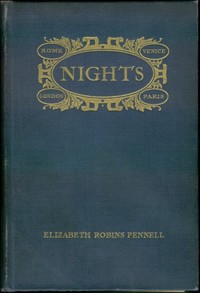
For Nights: Rome, Venice, in the Aesthetic Eighties; London, Paris, in the Fighting Nineties — Text and Context, the stored edition analysis reports 69,032 words, 5 hr 1 min estimated reading time, and 10 detected text sections.
The text analysis averages about 32.6 words per sentence, while the detected sections provide another way to judge how the source is divided.
Project Gutenberg metadata also associates the work with “Rome (Italy) -- Description and travel,” connecting these edition facts with the source record’s subject description.
Explore this collection
These alternatives are selected using recorded categories and estimated reading time.
About 300 minutes
Geography
68,886 recorded words. 1 minutes difference from this book's estimate.
View Gutenberg source #48408About 304 minutes
Geography
69,728 recorded words. 3 minutes difference from this book's estimate.
View Gutenberg source #29306About 313 minutes
Geography
71,826 recorded words. 12 minutes difference from this book's estimate.
View Gutenberg source #48358Search stored excerpts and compare books → Choose by your preferences →
Choices use stored catalog measurements. Estimates vary with reading speed. A shared category is a catalog label, not a claim that two books have the same argument or literary quality.
Search reads excerpt text stored with this catalog and links to its associated Gutenberg record. The connection is stored in the site database; this tool does not recheck that every excerpt is word-for-word identical to that external record. Excerpt search does not cover every chapter and does not verify historical publication dates.
Catalog snapshot checked: 2026-09-25. Coverage: 95 public books, 95 available source excerpts.
Read the complete public-domain text at its original source.
Read on Project GutenbergPennell opens her preface with an analogy: revisiting old memories is like taking down old favourites from bookshelves to see how they have worn. She applies this test to her 'Nights of long ago' and finds them still 'vivid and vociferous and full of life,' prompting her to revive them. This framing sets the tone for a work that is less a systematic travelogue and more a personal, impressionistic retrieval of past experiences.
The excerpts suggest the book is structured around cities and decades—Rome and Venice in the 'Aesthetic Eighties,' London and Paris in the 'Fighting Nineties'—but the surviving text focuses heavily on character sketches. Pennell’s method is anecdotal: she recalls specific individuals, their talk, and their habits, using them to evoke the atmosphere of a place and time.
Pennell’s preface establishes a deliberate, reflective approach to memory. She describes taking down memories 'much as we take down old favourites from our bookshelves,' testing how they have worn over time. This metaphor recurs implicitly throughout the excerpts: the book itself becomes a shelf of recollections, each chapter a volume. The preface also reveals a tension between holding onto memories and letting them 'drift back once more into unfriendly silence.' Pennell chooses to hold on, but she is aware that memory is selective—she revives only those nights that 'stand the test.'
This framing is crucial for a first reading: it signals that the following chapters are not neutral reports but curated, emotionally charged retrievals. Readers should expect a subjective, even nostalgic tone, where the author’s affection for her subjects colours every description.
The longest excerpt is a portrait of Henry Harland, the novelist. Pennell contrasts him with Bob Stevenson: Harland’s talk and writing were of a piece—'as he talked, so he wrote'—while Stevenson’s writing never captured his conversational brilliance. She notes that Harland 'believed in plunging into it headlong and getting everything that is to be got out of it,' and that his novels serve as a 'magic carpet' back to the Thursday nights in Buckingham Street.
Pennell’s method here is to use a single figure to evoke an entire milieu. She does not describe the room or the city in detail; instead, she lets Harland’s personality stand for the 'crowded, smoky rooms overlooking the river.' For a first-time reader, this suggests that the book’s real subject is not the cities themselves but the people who animated them. The portraits are intimate, often rueful—she regrets not having recorded more of Harland’s talk.
In a passage about an unnamed friend (possibly a painter), Pennell explores the boundary between romance and reality. She initially dismisses his complaints of illness as 'romancing' and 'playing the hypochondriac,' part of his 'rôle of middle-age.' She observes his dragging leg as 'the visible sign' that he could 'turn romance into reality as easily as reality into romance.' Only later does she learn that his illness was 'grim reality,' and she reproaches herself for taking it lightly.
This anecdote reveals a recurring theme: the difficulty of distinguishing between performance and truth in artistic circles. Pennell’s self-criticism—'I wish I had had the common sense to do what I could to make him live as a pleasure and a stimulus to others'—adds a layer of melancholy. The passage also demonstrates her narrative technique: she builds a scene around a small, telling detail (the dragging leg) and then undercuts it with hindsight.
The book’s title promises a division by city and decade, but the excerpts suggest that the actual structure is more fluid. The preface and the Harland sketch are from the London/Paris section, yet they contain no explicit geographical markers. Instead, place emerges through association: Buckingham Street, Kew, the Thames. Pennell’s focus is on the 'Thursday nights'—a recurring social event—rather than on the city itself.
For a first reading, it is helpful to expect that each 'night' may be less a travel chapter and more a vignette centred on a person, a conversation, or a single evening. The chronological frame (Eighties vs. Nineties) may serve to mark shifts in tone—from aestheticism to a more combative 'fighting' spirit—but the excerpts do not yet illustrate that contrast. Readers should attend to how Pennell uses specific people to anchor her memories of place.
Pennell’s Nights is best approached as a series of intimate, retrospective portraits rather than a conventional travel memoir. The excerpts reveal an author who is acutely aware of the gap between past and present, and who uses small, concrete details—a dragging leg, a crowded room, a turn of phrase—to summon entire worlds. Readers will find that the book rewards attention to its digressions and asides, where the most telling observations often lie.
Pennell’s nights in Rome and Venice shimmer with the glow of remembered conversation, those fleeting truths told between candlelight and dawn. I find that same patient warmth in The Mountains of Oregon — Reading Notes, where a quieter solitude breathes through every line. Both worlds hold their ghosts tenderly, asking only that we pause near them awhile.
Save your reaction, strongest insight, and memorable passage.