About 361 minutes
Brazil and the River Plate in 1868 — Context and Discussion
Geography
83,019 recorded words. 2 minutes difference from this book's estimate.
View Gutenberg source #52965
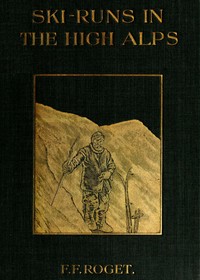
This digital edition of Ski-runs in the High Alps — Context and Discussion is described by source-level measurements including 83,417 words, 6 hr 3 min estimated reading time, and 10 detected text sections.
The text analysis averages about 21.7 words per sentence, while the detected sections provide another way to judge how the source is divided.
Project Gutenberg metadata also associates the work with “Alps -- Description and travel,” connecting these edition facts with the source record’s subject description.
Explore this collection
These alternatives are selected using recorded categories and estimated reading time.
About 361 minutes
Geography
83,019 recorded words. 2 minutes difference from this book's estimate.
View Gutenberg source #52965About 353 minutes
Geography
80,962 recorded words. 10 minutes difference from this book's estimate.
View Gutenberg source #35156About 348 minutes
Geography
80,023 recorded words. 15 minutes difference from this book's estimate.
View Gutenberg source #38891Search stored excerpts and compare books → Choose by your preferences →
Choices use stored catalog measurements. Estimates vary with reading speed. A shared category is a catalog label, not a claim that two books have the same argument or literary quality.
Search reads excerpt text stored with this catalog and links to its associated Gutenberg record. The connection is stored in the site database; this tool does not recheck that every excerpt is word-for-word identical to that external record. Excerpt search does not cover every chapter and does not verify historical publication dates.
Catalog snapshot checked: 2026-09-25. Coverage: 95 public books, 95 available source excerpts.
Read the complete public-domain text at its original source.
Read on Project GutenbergF. F. Roget was nearly fifty when he bought his first skis—not for himself, but for his seven-year-old daughter. That practical purchase, recounted in the preface, launched him into what he calls the “New Mountaineering.” Ski-runs in the High Alps (1913) records his winter ascents of Swiss passes and peaks, combining the precision of a seasoned alpinist with the fresh eye of a late convert. The book is neither a dry manual nor a mere travelogue; it moves between technical notes on snow conditions and passages of striking descriptive prose, often quoting fellow climbers like Arnold Lunn. Roget’s voice is wry, self-aware, and attentive to the peculiar beauty of the winter Alps—a landscape he finds both harsher and more delicate than its summer counterpart.
Roget frames his entire project around a personal confession: he bought skis for his daughter to play with, then bought a rough pair for himself, imagining himself “as a Newfoundland dog, on the brink of the waves, ready to rescue a child from snow peril.” The self-deprecating image sets the tone. He was “born again into a ski-runner” only after equipping himself, and the book is the record of that second birth. The preface makes clear that Ski-runs in the High Alps is not a beginner’s guide—that role is filled by W. Rickmer Rickmers’s companion volume, advertised on the front matter. Instead, Roget’s work belongs to the “New Mountaineering,” a winter counterpart to the summer alpinism that had long defined Swiss exploration. He revisits familiar passes and peaks, but in snow, with skis, and with a different set of challenges: assessing avalanche risk, reading wind-carved snow, and managing the peculiar fatigue of cold-weather exertion.
The excerpt from the Finsteraarhorn climb shows Roget at his most observant. He notes the “cross light effects,” silvery at one end and golden at the other, meeting on “that endless expanse of neutral white.” The rocky arête is described as “a lace ruff above its shoulder,” free from snow and ice because of the sun’s rays “percolating through the superimposed layers of dry air.” Such meteorological precision sits alongside a quoted passage from Arnold Lunn, who describes the summit as “the very hub of vast spaces of eternal winter.” Roget’s own prose then returns to the physical: the guides sleeping in the snow, the “alarming ski tracks” on steep slopes, the rope party arranged like a classical allusion—the Socialist, Achilles, Ulysses. The blend of technical detail, literary quotation, and wry characterisation gives the narrative a distinctive texture, part field report, part meditation.
Throughout the excerpt, Roget emphasises how winter alters the familiar Alpine landscape. The view from the Finsteraarhorn is “perfect, as only a winter view can be,” with a “vast sea of cloud” covering the plains. The winter atmosphere “toned down the harsh features whilst rendering the whole flawless panorama strangely distinct.” Mountains take on “wonderful bluish tints,” their crudities softened, their barren places made smooth. Roget captures a paradox: winter both simplifies and enriches. The cold air clarifies distances, while snow conceals the summer’s rough edges. He describes the cloud canopy as “a huge soft beast” filling the interstices of the vista, shot through with waves of light. This attention to atmospheric effects—light, colour, texture—suggests that Roget’s interest lies as much in perception as in physical achievement. The winter mountains are not merely obstacles to be conquered but phenomena to be seen and felt.
Readers approaching Ski-runs in the High Alps should expect a hybrid work: part personal narrative, part alpine observation, part anthology of quoted companions. Roget does not provide a systematic guide to routes or techniques; instead, he offers a series of winter excursions filtered through a reflective, sometimes playful sensibility. The book rewards those who read for the specific detail—the feel of a warm arête, the colour of a winter sky, the shape of a cloud—as much as for the arc of the climb. It is a record of a particular moment in mountaineering history, when skis were still a novelty in the high Alps, and when the mountains could still be seen anew.
Roget’s winter alps felt less like a guidebook and more like a quiet companion — someone who’d learned joy late and wanted to share the glow, not the route. It reminded me of another lingering read, Out and About London — Story, Setting & Ideas, where the city becomes a similar kind of slow, personal discovery. Both stayed with me like a half-remembered afternoon.
Use these questions to collect your thoughts before moving on.