About 353 minutes
The South-West, by a Yankee. In Two Volumes. Volume 2 — Context and Discussion
Geography
80,962 recorded words. 5 minutes difference from this book's estimate.
View Gutenberg source #35156
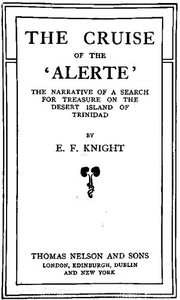
The Cruise of the 'Alerte' The narrative of a search for treasure on the desert island of Trinidad — Reading Notes can be approached with a clearer sense of reading commitment from its source measurements: 80,023 words, 5 hr 48 min estimated reading time, and 9 detected text sections.
The text analysis averages about 26.6 words per sentence, while the detected sections provide another way to judge how the source is divided.
Project Gutenberg metadata also associates the work with “Voyages and travels,” connecting these edition facts with the source record’s subject description.
Explore this collection
These alternatives are selected using recorded categories and estimated reading time.
About 353 minutes
Geography
80,962 recorded words. 5 minutes difference from this book's estimate.
View Gutenberg source #35156About 361 minutes
Geography
83,019 recorded words. 13 minutes difference from this book's estimate.
View Gutenberg source #52965About 363 minutes
Geography
83,417 recorded words. 15 minutes difference from this book's estimate.
View Gutenberg source #54163Search stored excerpts and compare books → Choose by your preferences →
Choices use stored catalog measurements. Estimates vary with reading speed. A shared category is a catalog label, not a claim that two books have the same argument or literary quality.
Search reads excerpt text stored with this catalog and links to its associated Gutenberg record. The connection is stored in the site database; this tool does not recheck that every excerpt is word-for-word identical to that external record. Excerpt search does not cover every chapter and does not verify historical publication dates.
Catalog snapshot checked: 2026-09-25. Coverage: 95 public books, 95 available source excerpts.
Read the complete public-domain text at its original source.
Read on Project GutenbergKnight opens his narrative not with the voyage itself but with the backstory of the treasure, establishing a pattern of layered exposition. The first chapter, 'The History of the Treasure,' sets up a quest that is as much about piecing together old accounts as about physical digging. The excerpts show a writer attentive to geological change: a ravine he knew nine years earlier has been obliterated by a landslip, forcing him to recalibrate his route. This moment—when he cries out in recognition of 'my ravine'—reveals a narrator who trusts his memory but must adapt to a shifting landscape.
The most striking passage in the excerpts describes Knight's return to a ravine he had descended nine years before. He finds it 'strangely familiar' yet radically altered: a 'gigantic landslip' has filled the upper part with millions of tons of rock, erasing the old path. The new route is treacherous, with 'no certain foothold' on a precipitous step. Knight does not merely report this; he uses it to illustrate the island's volatility, noting that 'enormous changes have taken place on this island even in the course of the last nine years.' This observation is grounded in specific detail—the soft soil, crab burrows, and entangling vegetation that impede progress. The ravine also hosts aggressive gannets whose nests and rotten fish create a 'hot narrow gorge' that 'stank most offensively.' Knight's descriptive precision gives the scene a sensory weight that anchors his broader narrative.
Among the natural chaos, Knight spots a 'bank of stones' of 'far too regular formation to be otherwise than the work of men's hands.' He identifies it as a remnant of a Portuguese penal settlement, 'some hundreds of years old.' This detail is typical of his method: he reads the landscape for clues, distinguishing between natural and artificial features. The road, now broken by the landslip, becomes a practical problem—it is 'useless to establish a depot of stores at the pier' because the pass is too dangerous. Knight's narrative is driven by such logistical calculations. He promises to describe the ruins later, and the excerpts confirm he does explore them. This forward reference creates a sense of an unfolding investigation, where each discovery leads to the next.
The title gives the yacht 'Alerte' equal billing with the treasure, and the excerpts show why. Knight devotes chapters to fitting out the vessel and selecting the ship's company. The opening pages list a uniform series of other travel narratives—'The Cruise of the Falcon,' 'The Voyage of the Discovery'—placing his own book in a tradition of small-boat exploration. The 'Alerte' is not just transport but a base of operations, a home, and a constraint. When Knight describes 'running down the trades' or being 'hove to,' he is documenting the rhythms of sail that govern the expedition's pace. The shore party's adventures and the decision to abandon the search are framed by the yacht's schedule. Readers should attend to how Knight balances shipboard routine with island exploration; the two are interdependent.
Knight presents himself as a careful observer who learns from failure. The excerpts show him reasoning from evidence: the landslip explains why he could not find his old route; the birds' eggs taste of 'rotten fish,' a detail that is both vivid and functional. He does not claim certainty about the treasure's location. Instead, he documents the search process—the pick and shovel work, the exploration of South-west Bay, the decision to abandon. The chapter titles themselves form a chronology of effort: 'We explore the Ravine,' 'We Land the Stores,' 'Our Camp.' Knight's tone is matter-of-fact, even when describing narrow escapes. This understatement invites the reader to share in the detective work, weighing the same clues he does. The narrative rewards attention to small observations, which often prove significant later.
Knight's narrative is best approached as a documentary of a specific expedition, not a treasure-hunt thriller. The pleasure lies in following his reasoning, noting how he interprets the island's geology and traces of past inhabitants. The excerpts suggest that the real discovery is not gold but a landscape in constant flux—ravines that vanish, roads that become deadly. Readers who enjoy travel writing that values precision over drama will find Knight a congenial guide.
I kept thinking about how Knight returned to that ravine nine years later, and found the island had quietly rearranged itself. There's something tender about that—watching a place change, admitting you can't hold it still. It reminded me of Alaska Days with John Muir — Reading Companion, where the landscape also shifts beneath the observer, only faster, more alive. Both books make me ache for places I've never seen.
Capture what you thought, learned, and would like to remember.